
My stepfather stormed into my army quarters, beating me until my shoulder gave out and my face was covered in blood — while my own mother stood there… frozen, silent, not saying a word.
I was already on edge that night. A strange letter from a law office. My father’s name — the one I hadn’t heard in years. Something about a key. Something that didn’t make sense.
Then my phone lit up with a message from an unknown number:
“Where is the key?”
Seconds later… everything spiraled into violence.
With the last bit of strength I had left, I sent out an SOS — and collapsed, thinking it was over.
But what happened after that… shocked even the Special Forces.
At Midnight, My Stepfather Beat Me—My SOS Text Brought the Special Forces to My Rescue
At Midnight, My Stepfather Stormed Into My Army Quarters – Beating Me Until My Shoulder Dislocated And Blood Covered My Face – While My Mother Stood Frozen In Silence. With My Last Strength, I Sent An SOS And Collapsed. What Happened Next… Stunned The Special Forces.
Part 1
The hallway outside my apartment always smelled faintly like floor wax and somebody’s burnt microwave popcorn. That night it was worse—sharp, chemical, like the cleaning crew had gotten ambitious. I’d just come off a late shift and I was still wearing the base’s fluorescent light in my eyes, that ghostly afterimage that makes your living room feel like a set instead of a home.
My place was small. One bedroom. A couch that squeaked when you sat on the wrong cushion. A folding table I used as a desk because I kept telling myself I’d buy real furniture “after things settled down,” like life ever does that.
On the counter, my keys sat in the little ceramic bowl I’d grabbed from the thrift store. Next to them was an envelope I hadn’t opened.
The return address was from a law office back in Ohio.
I’d stared at it all evening like it might bite.
At 11:43 p.m., my phone lit up on the couch with my mother’s name.
Mom: Call me. Please.
I didn’t. I let it sit there and glow itself back to sleep.
Because the last time I answered, she’d sounded like she was speaking through a blanket. Quiet. Breath hitching. And then, just when I’d started to form the words, I’d heard him in the background—Dean Mercer, my stepfather—clearing his throat like he was reminding her who owned the air.
“Everything’s fine,” she’d said too quickly, like she was reading off a script taped to the wall.
I’d gotten good at hearing what wasn’t said.
I turned on the kitchen faucet and listened to the water run. Sometimes the noise helped. Sometimes it made the silence afterward feel even bigger. I rinsed out my coffee mug, the one with the chipped rim, and I caught myself doing that thing where you check the lock without meaning to. Deadbolt. Chain.
My shoulders loosened a fraction.
Then I saw the envelope again.
Fine. I told myself. Open it. Rip off the bandage.
I slid my finger under the flap and tore. Paper fibers caught under my nail. The letter inside was thick, expensive. The kind of stationery that tries to make grief look organized.
I read the first line and felt the room tilt.
“Ms. Ray—”
Ray. Not my mother’s married name. Not Dean’s. Mine.
“In regard to the estate of Thomas Ray…”
My dad’s name hit me like a smell. Like the burned metal tang of his workshop, like the peppermint gum he always chewed when he was thinking. My throat tightened before I got to the second paragraph.
There was something about a safety deposit box. A key. A note that had been filed but never delivered. “Previously unlocated documentation.”
Previously unlocated. Like my dad was a set of misplaced car keys.
My phone buzzed again.
Unknown Number.
I watched it ring without picking up. The screen stopped. Then a text came through.
Where is the key?
My skin went cold in a quick, ugly wave. Not the slow fear you can talk yourself out of. The kind that makes your body decide before your brain catches up.
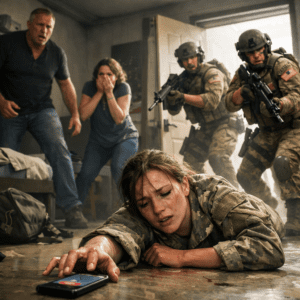
Another text followed immediately.
Don’t make this hard.
I set the phone down like it was hot. My palms were suddenly damp. The envelope in my hand felt heavier now, like it had turned into a weapon.
I told myself it was a scam. A random phishing text. Somebody guessing.
But my stepfather had asked about my dad’s “papers” exactly once, years ago, on the night my mother married him.
He’d said it casually, like he was asking where we kept the extra towels.
“So… your father didn’t leave anything squirreled away, right?”
My mother had laughed, too high and too bright. “Dean.”
His eyes had flicked to me anyway.
Like he was checking whether I remembered what didn’t belong to him.
I didn’t open the rest of the letter. I couldn’t. My fingers were stiff. I folded it back into the envelope with a care that didn’t make sense.
I walked into the bedroom and pulled open the bottom drawer of my dresser. Under socks and PT shirts was a small lockbox. The metal was cool, almost damp. I put my hand on it.
The key wasn’t in there.
I’d moved it last month. After my mother’s last call. After the way Dean’s breathing had sounded near the phone, like he was standing close enough to taste my name through the speaker.
I backed up, my heel catching the edge of the rug. For a second I pictured Dean’s hands—big, blunt-knuckled, always a little scraped up from “work.” He’d been a fire inspector. He liked telling stories about burned houses like they were campfire tales. He liked details. How fast the flames climbed. What plastic smelled like when it melted.
He liked control.
I’d just started to convince myself I was overreacting when the knock came.
Not loud. Not frantic.
Three taps.
Tap. Tap. Tap.
My body went rigid.
I waited for the next sound—footsteps, a neighbor’s voice, somebody calling out the wrong apartment number.
Nothing.
The building’s heater clicked somewhere in the wall. Outside, wind skated along the walkway, making a faint, dry scrape.
Tap. Tap. Tap.
I didn’t ask who it was. My voice was stuck behind my teeth. I moved toward the door anyway, slow, like my muscles had to negotiate each step.
Through the peephole I saw the walkway, washed in pale orange from the sodium light. Empty. No shape. No face.
Then, just at the edge of the frame, something shifted—like someone had been standing pressed flat against the wall beside my door.
My stomach dropped.
Before I could step back, the chain rattled.
Something hit the door hard enough to make the hinges groan.
The second impact blew the chain clean out of the drywall with a crack like a gunshot.
The door flew inward.
Dean filled the doorway, wet with sweat or rain, I couldn’t tell which. His hair was darker than I remembered, plastered to his forehead. His eyes had that glassy brightness of someone who’d been awake too long with a single thought chewing through his skull.
He didn’t say hello.
He stepped in and slammed the door shut behind him.
“You shouldn’t ignore your mother,” he said, voice low, almost conversational.
I backed up automatically, hands rising, palms out. “You need to leave.”
He smiled, but it didn’t touch his eyes. “I drove a long way. Don’t waste my time.”
My heart was hammering. My living room suddenly felt like a shoebox. My phone was on the couch behind him. My bedroom was behind me. Everything I owned was in this space and none of it mattered.
“What do you want?” I asked, and I hated the shake in my voice.
His gaze flicked past me, quick and assessing—like he was mapping exits. “The key.”
I swallowed. “I don’t know what you’re talking about.”
He moved faster than I expected. One second he was a few feet away, the next his hand was at my throat, not squeezing yet, just claiming the spot.
“You do,” he said softly. “Your father thought he was clever.”
My skin prickled. “Don’t talk about my dad.”
His grip tightened like a reflex. “Give it to me.”
I tried to twist away, bringing my forearm up the way I’d been trained, aiming to break the hold. But he was stronger than he looked in his Facebook family photos. He drove me backward into the corner of the couch. The air left my lungs in a sharp burst.
I reached behind me for the phone, fingers scrabbling against upholstery. My hand hit it, slick glass under my palm, and I yanked it up.
Dean saw it and slammed his fist down. My phone flew out of my hand, skidding across the floor.
I lunged for it anyway.
He caught me by the back of my shirt and threw me sideways. My shoulder hit the coffee table. Pain flashed hot and immediate. The table wobbled. A framed photo toppled—the one of my unit at a range day, all of us squinting into the sun, pretending we weren’t tired.
Dean stepped over it without looking down.
“You think those guys can save you?” he sneered. “This is family business.”
I kicked backward, catching his shin. He grunted, more annoyed than hurt, and then his hand was in my hair. He yanked my head back hard enough that spots burst behind my eyes.
“Last chance,” he said, breath sour like old coffee. “Where is it?”
My vision tunneled. My mind did that strange thing it does under pressure—hyper-clear on useless details. The scratch on his wrist. The damp edge of his sleeve. The way his pupils looked almost too wide.
My fingers found the phone again by pure luck. It was face down. I flipped it, screen cracked but still lit.
Dean’s hand clamped around my throat.
My lungs fought. My body started to panic.
But muscle memory is a stubborn animal.
I unlocked the phone with my thumb without looking. Messages. Recent. The top thread.
COYOTE.
A group chat that never slept, even when we did.
My fingers tapped three letters.
S O S.
I hit send.
Dean slammed me down and the world went white at the edges.
And through the blur, right before my eyes rolled back, I saw someone in the doorway behind him.
My mother.
Not rushing in. Not screaming. Just standing there with her coat still on, her hands clenched around my dad’s old keychain—his faded leather tag swinging like a tiny pendulum.
Her eyes met mine, empty as a turned-off screen, and my chest cracked with a betrayal so sharp I could taste it—because if she was here, then who invited him?
Part 2
I woke up to antiseptic and the steady beep of machines that sounded like a metronome for someone else’s life.
My mouth tasted like pennies. My throat felt scraped raw, like I’d swallowed sand. When I tried to lift my left arm, pain hit so hard my vision pinched shut.
A hand pressed gently on my forearm. “Don’t.”
I forced my eyes open.
Jules Navarro was sitting beside my bed with a hospital coffee in her hand, the kind that smells burnt before you even sip it. Her dark hair was pulled into a messy knot. She looked like she’d run here without thinking about shoes.
“You’re awake,” she said, voice steady but her eyes too bright.
“What—” My throat shredded the word.
“Easy.” She leaned closer. “You’re at the base hospital. You’ve been out almost a day.”
My mind tried to rewind, but it stuttered on the same frame: Dean’s hand on my throat. My mother in the doorway. That empty look.
I swallowed and regretted it. “Where is he?”
Jules’s jaw tightened. “In cuffs.”
Relief should’ve been a warm thing. Instead it came like ice, sliding through my ribs. “And my mom?”
Jules didn’t answer right away. That pause told me more than words.
“She’s here,” Jules said finally. “Different wing.”
I stared at the ceiling tiles, the little pinholes like a thousand tiny eyes. “Did she… did she call for help?”
Jules’s gaze flicked away, toward the door. “MPs found her in a car in the parking lot. She wasn’t talking. Just… staring.”
Staring. Like she’d watched me.
My pulse thumped against the monitors. “So she came with him.”
“We don’t know the full story,” Jules said quickly, like she was trying to keep me from tearing my own stitches. “Focus on you.”
But my body wouldn’t stay focused. It wanted answers like oxygen.
The door opened and a nurse came in, checking my IV, shining a light in my eyes. My shoulder was strapped tight, immobilized. When she pressed fingers along my collarbone I hissed.
“Dislocation,” she said, matter-of-fact. “They reduced it in the ER. You’re lucky.”
Lucky.
I thought about Dean’s fingers squeezing my airway shut. Thought about the way my mother hadn’t moved.
Yeah. Lucky.
When the nurse left, Jules set her coffee down and leaned forward. “Your SOS lit up the whole chat.”
I remembered my thumb hitting send. The cold glass. The blur.
“What happened?” I asked.
Jules exhaled. “Keenan and Ross live two buildings over. They were at home. They got there first. Door was already wrecked, so they didn’t bother knocking. They dragged him off you and held him until MPs rolled up.”
I pictured it—Keenan, all elbows and impatience, Ross with his calm, quiet fury. The kind of guys who don’t waste words when there’s work to do.
“Did he have a weapon?” I asked.
Jules’s mouth tightened. “He had zip ties in his pocket. And a roll of duct tape. And…” She glanced at my nightstand.
A clear evidence bag sat there like a bad joke. Inside it was my phone, screen spiderwebbed, and beside it—another bag, smaller.
A key.
Not mine. Not the one my dad had hidden. This one was shiny, modern, with a stamped logo from a bank.
My stomach turned.
“That was in his jacket,” Jules said. “CID is asking questions.”
I tried to sit up and the world swayed. Jules steadied me. “Easy, Tessa.”
I hadn’t told her about the letter yet. About the texts.
“Jules,” I whispered, “I got a message last night. Someone asked me where ‘the key’ was.”
Jules went very still. “You told CID?”
“No.” My throat tightened again. “I didn’t get the chance.”
The door opened again, and this time it wasn’t a nurse.
A woman in a crisp uniform stepped in, hair pulled back tight, eyes sharp like she’d been trained to spot lies from across a room. Her name tape read H. PARKER.
“Staff Sergeant Ray?” she asked.
I nodded.
“I’m Captain Parker,” she said, pulling a chair to the side of my bed. “Legal. I’m going to ask you a few questions. If you need a break, say so.”
Her voice was calm, but it had weight. The kind of calm that comes from standing near storms without getting wet.
Jules started to stand. Parker raised a hand. “She can stay if you want.”
I looked at Jules. She gave me a small nod, like a promise.
Parker opened a folder. “We have Mr. Mercer in custody. Because this happened on a federal installation, the charges will stack fast. But there’s something else.”
Of course there was.
Parker slid a photograph across my blanket.
It was grainy, like from a security camera. A bank lobby. A woman at the counter.
My mother.
Her hair was pulled back the way she used to wear it when she was nervous. She was holding an envelope in both hands like it might fly away. Her shoulders were hunched, small.
And behind her, half out of frame, was Dean—standing close enough that it looked like he was breathing into her neck.
My ears rang.
“This was yesterday,” Parker said. “Local time, back home. Branch manager remembers them. Your mother accessed a safety deposit box registered under Thomas Ray’s name.”
My dad’s name.
I tasted metal again, stronger now.
Parker watched my face carefully. “Did you know your father had a box?”
“No.” The word came out too fast. Then I remembered the letter sitting in my kitchen, unopened now except for that first page. I remembered “previously unlocated documentation.”
My hands started to shake. “I got a letter. From a lawyer. Last night.”
Parker’s eyes sharpened. “What did it say?”
I swallowed. “Something about the estate. A key. A box.”
Parker flipped to a new page in her folder. “CID recovered an envelope in your apartment. Torn open. Law firm letterhead.”
My stomach sank. “He went through my mail.”
“Yes.” Parker’s voice stayed level, but her gaze got colder. “And we believe your mother may have helped him get close enough to do it.”
The room felt smaller, like the walls were inching in. I couldn’t get enough air even though nobody was choking me now.
Jules’s hand found mine, squeezing hard.
Parker slid another item across my blanket.
A screenshot printout.
A text message log from my mother’s phone, recovered after she was brought in.
One line was highlighted.
Dean: If she won’t hand it over, we take it.
My vision blurred, hot and fast. Not from pain this time.
From the sudden, sick realization that the empty look on my mother’s face wasn’t shock.
It was rehearsal.
And if she and Dean had already emptied my father’s box back home… then what, exactly, had they driven all this way to take from me?
Part 3
When I was thirteen, I learned what burned insulation smells like.
It’s not like wood smoke. It doesn’t feel natural. It’s sharp and oily, like melted plastic and electricity and something else you can’t name. It sticks to the back of your throat and lives there.
The night our garage caught fire, I woke up coughing before I heard the sirens.
My dad had been out there late, like always, tinkering. He loved fixing things that weren’t worth fixing. He said it was practice for the world—learn how to repair what people throw away.
I remember the orange light under my bedroom door. The way the smoke alarm sounded like a terrified bird.
My mother ran into my room barefoot, hair wild, face pale. “Tessa, get up.”
I ran, and in the driveway the winter air hit my lungs like glass. Neighbors stood in their pajamas. Someone’s dog barked like it understood.
The flames climbed the garage door in waves.
And then Dean Mercer showed up.
Not as my stepfather. Not yet.
He stepped out of a county SUV in a heavy coat, flashlight in hand, calm as if he’d done this a thousand times. Which he had. Fire inspector. The guy who walked into charred ruins after everyone else had walked away.
He asked my mother questions in a steady voice while she shook so hard she could barely speak.
He didn’t ask me anything. But he looked at me.
Not like a concerned adult.
Like a man memorizing a room.
My dad didn’t make it out.
They said it was fast. They said he probably didn’t feel much. They said all the things people say when they want you to stop asking for details.
My mother folded in on herself after that. Not dramatically. Quietly. Like a tent collapsing when you pull the wrong pole. She started forgetting to eat. Forgetting to answer the phone. Forgetting to pick up prescriptions.
And Dean—Dean was suddenly everywhere.
He came by with paperwork. He offered to “walk her through the process.” He explained insurance terms with the ease of someone reading a menu.
He fixed little things around the house. The porch step that wobbled. The hallway light that flickered. He brought my mom coffee in the mornings and made a show of setting it down gently, like tenderness was a performance.
I hated him from the beginning, but hate is hard to sell when everyone else sees a savior.
Two years later, when my mother married him in our living room with a judge who smelled like cologne and chewing gum, Dean hugged me after the photos.
His arms were heavy. His mouth was close to my ear.
“You’re smart,” he whispered. “So don’t make me repeat myself.”
I didn’t know what he meant yet, but my skin crawled anyway.
The control started small.
My bedroom door didn’t latch anymore. Dean said he’d fix it. He didn’t.
If I talked too long on the phone, he’d stand in the hallway and clear his throat until my voice got quieter. If I wanted to go out with friends, he’d ask a hundred questions with a smile that never reached his eyes.
And money—money was the leash he liked best.
He “helped” my mom handle bills, then slowly turned every conversation into a lecture about what we could afford. He started opening her mail. Then mine.
When I got my first job at a grocery store, he showed up on payday and asked me to hand him my check “so we can deposit it properly.”
I said no.
He stared at me like I’d spoken a foreign language.
My mother didn’t defend me. She looked down at her hands and whispered, “Tessa… just do it. Please.”
That was the first time I realized she wasn’t just scared of being alone.
She was scared of him.
The key entered my life like a splinter.
I found it in one of my dad’s old toolboxes the summer before I left for basic. It was taped inside a small metal tin, the kind he used for screws. The tape was old and yellowed.
On top of it was a folded piece of paper in my dad’s handwriting.
Tess—
If anything happens and you don’t trust the house, go to Harbor Federal. Box 112. Ask for Marlene.
Don’t tell anyone.
My heart had hammered so hard I thought Dean could hear it from the kitchen.
I’d slid the tin into my hoodie pocket and walked out of the garage like I wasn’t carrying a secret that could change everything.
I didn’t know what was in the box. I just knew my dad had hidden it from the house.
From Dean.
For years, I kept that key like a tooth under my tongue. I didn’t use it. I didn’t mention it. I just held it close as proof that my dad had seen something coming.
When I turned eighteen, I enlisted.
Not because I was patriotic in that simple, flag-waving way people assume. I enlisted because the military had one thing my house didn’t:
Rules that applied to everyone.
Dean couldn’t just invent consequences in that world. He couldn’t decide my future over dinner.
He tried anyway.
On the night I left, he stood in the driveway with his hands in his pockets, watching me load my duffel into a friend’s car. He didn’t stop me. He didn’t yell. He just smiled and said, “You’ll come crawling back.”
I didn’t look at him. I didn’t answer.
I should’ve known he wouldn’t let it end there.
Back in the hospital bed, years later, that memory tasted like bitter coffee.
Captain Parker returned with a stack of documents. “We got a warrant for the box your mother accessed,” she said. “It was emptied yesterday.”
“By her,” I said, voice flat.
Parker nodded. “Signed out under her name. With Mr. Mercer present.”
My hands clenched under the blanket. My shoulder screamed, but anger was louder.
“What was in it?” I asked.
Parker hesitated. “We don’t know. But the bank manager said your mother was… upset.”
I laughed once, sharp and humorless. “She’s always upset.”
Parker’s gaze held mine. “Staff Sergeant, we also recovered this.”
She placed a new evidence bag on my tray table.
Inside was my mother’s wallet.
And tucked behind her driver’s license was a small, bent photograph.
It was of me at thirteen, sitting on the front steps with my dad’s old dog in my lap. A summer day. Sun on my knees. My dad taking the photo, you could tell by the angle.
Except someone had scratched out my eyes with something sharp. Over and over until the paper was almost torn through.
My stomach turned.
That wasn’t fear.
That was hatred.
And suddenly, Dean’s midnight visit didn’t feel like a man acting alone—it felt like the final step in a plan they’d both been walking toward for years… so what, exactly, had my mother been saving that violence for?
Part 4
They kept my mother in the psychiatric wing for “evaluation,” which sounded gentle until you saw the reinforced glass and the way the doors locked with a heavy, final click.
When they wheeled me down the hall two days later, the hospital’s fluorescent lights made everything look washed out—skin, walls, even emotions. I smelled bleach and those fake lavender plug-ins they use to pretend places like this aren’t built for breakdowns.
A nurse pushed my chair, and Jules walked on my right like a shadow that refused to leave.
“You don’t have to do this,” Jules murmured.
“I do,” I said, though my voice didn’t sound like mine.
My mother was in a small room with a table bolted to the floor. She sat with her hands clasped, knuckles white, staring at the same spot on the tabletop like it might open and swallow her whole.
She looked up when I entered, and for a second I saw the mother I remembered—soft eyes, a mouth that used to smile without permission.
Then her gaze darted past me, toward the door.
Checking exits. Checking for Dean.
Even now.
“Tessa,” she whispered.
My throat tightened. “Don’t say my name like you didn’t hand it to him.”
Her eyes filled fast. “I didn’t—he—”
“No.” The word cut clean. “I saw the texts.”
She flinched like the word “texts” was a slap. Her hands trembled. “You don’t understand. He was… he was desperate.”
I leaned forward, shoulder aching, voice low. “So you were desperate enough to bring him to my door at midnight?”
Tears ran down her cheeks, but she didn’t wipe them away. “I didn’t think he’d hurt you.”
The lie was so smooth it scared me more than the truth.
“You didn’t think,” I repeated. “Or you didn’t care?”
Her lips parted. Closed. Then she swallowed and said, “He said your father left something. Something that belonged to us.”
“Us,” I echoed, and my laugh came out broken. “My father didn’t die for you to get a payout.”
Her face twisted. “You always think you know everything.”
That flash of irritation—sharp, quick—didn’t belong to a frightened victim. It belonged to someone who’d been holding resentment in their mouth for years, letting it dissolve slowly.
I stared at her. “Why was Dean at the bank with you?”
She looked down. “Because I… because he told me what to say.”
I leaned back, studying her, letting the silence stretch until it turned uncomfortable. The room hummed with ventilation. Somewhere down the hall, someone shouted once and then went quiet.
My mother licked her lips. “Tessa, you have to understand… after your father died, everything fell apart. Bills. Debt. I was drowning.”
“My father had life insurance,” I said. “And he had a good job. Where did it go?”
She didn’t answer.
Jules’s hand tightened on the back of my chair, the smallest movement, but I felt the anger in it.
I said, “You emptied a box in his name. A box he hid. From this house. From you.”
My mother’s breath hitched.
And then she made her mistake.
“He wouldn’t have had to hide things if you weren’t so stubborn,” she snapped, then froze as if she couldn’t believe what had come out of her own mouth.
My skin went cold.
“You knew,” I said quietly.
Her eyes flicked up, wild. “I knew he had secrets,” she said too fast. “Thomas was always—he always acted like I couldn’t handle the truth.”
“The truth,” I repeated. “Or the money?”
Her shoulders shook. “Dean said it was ours. That your father—” She swallowed hard. “That your father was selfish.”
I felt something inside me shift, like a door clicking shut.
“My father is dead,” I said, voice flat. “And you’re still letting a man rewrite him.”
Her eyes darted again, toward the door, like she expected Dean to walk in and rescue her from her own words.
I realized then she wasn’t just afraid of him.
She was loyal to him.
In the days that followed, the investigation moved like a machine. CID pulled bank footage. Parker’s team traced transfers from accounts I didn’t recognize—small withdrawals, frequent, for years. My military pay, siphoned off. A joint account I’d never opened.
My mother had been stealing from me while I slept under government blankets in places she couldn’t pronounce.
When Parker showed me the statements, I didn’t cry.
I felt hollow.
Dean got a public defender at first. Then, suddenly, he had a private attorney. Expensive. The kind that walked into the pretrial hearing like the courthouse belonged to him.
Money from somewhere.
Money from my father’s box.
At the hearing, Dean’s eyes met mine across the courtroom. He smiled like we were sharing a joke.
When they led him past my row in cuffs, he leaned close enough that I smelled mint gum on his breath.
“I know your Social,” he whispered, voice soft as a bedtime story. He recited the numbers perfectly, then smiled wider. “Midnight’s not a one-time thing.”
My stomach dropped.
That night, back in my apartment—door replaced, locks upgraded—I stared at my phone until my eyes burned.
At 12:01 a.m., an unknown number buzzed.
One message.
MIDNIGHT AGAIN?
My blood went cold, because the number wasn’t random—it was my mother’s area code… so was this Dean reaching for me from a cell, or my mother proving she could still open the cage from the inside?
Part 5
Trials aren’t like movies. There’s no perfect speech that fixes your life. There’s a lot of waiting under bad lighting, a lot of paperwork that smells like copier toner, and moments where you realize the worst day of your life has been turned into numbered exhibits.
I wore my dress uniform on the day I testified, not because I wanted to look impressive, but because I needed the reminder: I wasn’t thirteen on those front steps anymore. I wasn’t stuck in a house where a man could decide what my silence meant.
Jules sat behind me with Keenan and Ross, all of them stiff-backed and watchful. Not dramatic. Just present. The kind of presence that says, if you try something, you’ll regret it.
Dean sat at the defense table in a clean suit like he was interviewing for a bank job. His face was healed from the scuffle, but his eyes were the same—bright with entitlement.
Captain Parker walked me through questions like stepping-stones. Midnight. The forced entry. The assault. The zip ties. The duct tape. The texts. The bank footage. The transfers.
When the defense attorney tried to paint me as paranoid—an overtrained soldier seeing threats everywhere—I kept my voice even.
“I didn’t imagine bruises on my throat,” I said. “I didn’t imagine his fingerprints on my door. And I didn’t imagine my mother’s signature on the withdrawal slip.”
That last sentence landed hard. I heard it in the room—the small shift of bodies, the quiet intake of breath.
Dean’s jaw ticked.
Good.
The judge allowed my mother to testify too.
They brought her in looking small and pale, hair pulled back, hands shaking. She didn’t look at me at first. When she finally did, her eyes were wet, and for a second I almost felt the old ache rise—almost.
Then she opened her mouth.
“I was pressured,” she said. “I was afraid.”
Parker’s voice was calm. “Afraid enough to text him your daughter’s address on post?”
My mother flinched. “I didn’t think—”
Parker slid a printed message across the stand. “Afraid enough to tell him the gate code?”
My mother’s face crumpled. “He promised—he promised he only wanted to talk to her.”
“And the bank?” Parker asked. “You accessed the box. You signed it out. Why?”
My mother swallowed hard. “Because I was tired of being left with nothing.”
There it was.
Not fear.
Resentment.
She turned then, fully, eyes locking onto mine like she wanted me to rescue her from her own truth.
“I’m your mother,” she pleaded, voice cracking. “I didn’t mean for it to go that far. He—he made me feel like I finally mattered.”
The betrayal didn’t feel sharp anymore. It felt settled, heavy, final.
When Parker asked me afterward, quietly, if I wanted to speak to my mother in private before the verdict, my answer came without effort.
“No.”
Not because I was strong.
Because I was done.
The jury didn’t take long.
Guilty on all charges for Dean: attempted murder, aggravated assault, stalking, conspiracy, fraud tied to the stolen funds. The judge read the sentence in a voice that didn’t care about Dean’s charm.
When the gavel came down, Dean’s smile finally cracked. He stared at me like I’d cheated him.
As if my life was something he’d been robbed of.
My mother was sentenced too—less time, because the system loves the idea of a “coerced woman,” but enough that she cried when she heard the number of years. Restitution. Probation afterward. Mandatory counseling.
She reached for me as they led her out.
“Tessa,” she sobbed. “Please. Please, I’m sorry.”
I stepped back. Not dramatic. Just one simple movement that meant: you don’t get to touch me anymore.
Her hand hung in the air for a second, then dropped like something dead.
Afterward, I changed my number. Closed every account. Put fraud alerts on my credit. I asked the bank for copies of everything pulled from my father’s box, and when I finally saw what he’d hidden—documents, a small trust, and a letter that started with “If you’re reading this, it means I was right to be worried”—I didn’t feel victory.
I felt grief.
But it was clean grief, the kind that doesn’t come mixed with confusion anymore.
I moved off post into a place with big windows and too much sunlight, like I was trying to prove to my nervous system that brightness could be safe. I started volunteering with a quiet network that helps service members and their families get out of abusive homes without leaving a paper trail. We didn’t call it anything dramatic. We just answered when people reached out.
One evening, months later, as I was rinsing a coffee mug at my sink, my phone buzzed.
Unknown number.
A single text.
I can’t leave. He’ll kill me. Please.
For a second the old midnight cold tried to climb my spine—but then I saw Jules’s words in my head like a hand on my shoulder: You don’t have to do this alone.
My thumb hovered over the screen, heart thumping, and I typed back, steady and certain: I’m here. Where are you right now?
And as I hit send, I realized the question wasn’t whether midnight would ever come again—it was whether I was finally ready to be the lifeline I once begged for.
Part 6
The first thing I noticed after I hit send was how loud my refrigerator was.
Not in a broken way—just in that modern-apartment way where everything hums so you don’t have to hear your own thoughts. The freezer fan whirred. The ice maker clicked once, like it was clearing its throat. Somewhere outside my big windows, a car slid through wet pavement with that soft hiss that always makes me think of distant waves.
My phone stayed in my hand, screen glowing against my palm.
I’m here. Where are you right now?
For a full minute, nothing.
I told myself to breathe like I trained people to breathe. Slow in through the nose, slower out. But my body didn’t care about technique. It remembered midnight. It remembered wood splintering. It remembered a hand around my throat.
The phone buzzed.
Unknown number.
Behind the Shell station on Larkspur. Dumpster side. Please don’t call 911. He has a friend.
A second text followed, like they couldn’t help themselves.
It’s Marlene.
My stomach dropped so hard I actually felt it in my knees.
Marlene. The name in my dad’s note. The name I’d carried around like a loose thread I never tugged because I was afraid of what it would unravel.
I walked straight to my kitchen counter and grabbed my keys. The ceramic bowl clinked. My hands were steady, which almost scared me more than shaking.
I didn’t call 911.
I called Jules.
She answered on the second ring, voice rough with sleep. “Tess?”
“Marlene just texted me.” I kept my voice low, even though I was alone. Old habit. “She says she’s behind a Shell station on Larkspur. Says don’t call cops. Says he has a friend.”
There was a pause, the sound of Jules moving—fabric rustling, a drawer opening. “You’re not going alone.”
“I wasn’t planning to.”
“I’m coming,” she said. No questions. Just decision.
I sent one more text to Keenan, the kind with minimal words and maximum meaning.
Need eyes. Possible ambush. Larkspur Shell. Now.
Then I pulled on a hoodie and shoes and grabbed the small metal flashlight I kept in my junk drawer. It wasn’t tactical. It was something I bought at Target because the power went out once and I hated feeling helpless in the dark.
Down in the parking lot, the air smelled like rain and hot asphalt. The sky had that low, bruised look like it couldn’t decide whether to keep storming or quit. My car beeped when I unlocked it, too cheerful for the hour.
I drove with the radio off. I wanted to hear everything—engines, tires, the tiny shift of the world that might warn me.
Larkspur was a strip of half-lit businesses and closed diners, the kind of road that looks different at night. In daylight it’s boring. At midnight it feels like a place where people make bad decisions and pray no one notices.
The Shell station sat on the corner with bright lights that made the wet pavement shine like black glass. The front was empty. No customers. No cars at the pumps. The convenience store clerk leaned over his counter staring at his phone, bored and safe behind bulletproof glass.
I didn’t pull into the lot.
I parked across the street by a darkened laundromat and watched.
A minute later, Jules’ car slid up behind mine and stopped with her headlights off. Keenan’s truck followed, rolling quiet for something that big. He got out and shut his door without slamming it, which told me he was taking this seriously.
Jules came to my window. Her hair was still damp like she’d showered and then changed her mind halfway through. “Plan?”
“We’re assuming someone’s watching.” I nodded toward the back of the station where the dumpsters were lined up against a chain-link fence. “We go in slow. Two angles. If it smells wrong, we leave.”
Keenan came up on my other side, jaw set. “CID?”
“Not yet.” I hated the way that sounded, but I wasn’t about to explain bureaucracy at midnight.
We crossed the street together, keeping space between us like we were strangers who happened to be walking the same direction. The station lights buzzed overhead. A moth kept throwing itself at the fluorescent tube like it had a grudge.
Behind the building, the air shifted. It smelled like oil and sour trash and wet cardboard. The ground was uneven, gravel mixed with puddles. My shoes crunched softly.
And there—half-crouched beside the green dumpster, arms wrapped around herself—was a woman in a puffy jacket that looked too thin for the cold.
“Marlene?” I said, keeping my voice calm.
Her head snapped up. Her face was pale under the shadow of the dumpster lid. There was a bruise on her cheekbone, yellow at the edges like it was a few days old. Her hair was shoved under a beanie, but I could see streaks of gray at her temples.
“It’s you,” she breathed, like she’d been holding her lungs closed.
“I’m Tessa.” I took a step closer and stopped, giving her room. “Are you hurt?”
She shook her head too quickly, then winced like the motion hurt anyway. Her eyes kept darting past me, toward the street, toward the dark. “I shouldn’t have texted.”
“But you did,” Jules said gently, coming up on my left. “So tell us what’s going on.”
Marlene swallowed and reached into her jacket pocket with shaking fingers. She pulled out a small key ring and held it like it was burning her skin.
On it was a key with a bank logo.
Harbor Federal.
“I didn’t know what else to do,” she whispered. “I tried to do the right thing, and now I think I did the dangerous thing.”
Keenan shifted, scanning the fence line. “Who’s ‘he’?”
Marlene’s gaze flicked to me. “Not the one in prison.”
My skin went tight. “Dean has someone on the outside.”
She nodded once. “A man came to the bank after the trial. Not your stepfather. Different. Same eyes.” Her voice dropped. “He said he was family.”
Family. The word hit wrong. Like a glove turned inside out.
“What’s his name?” I asked.
Marlene hesitated. “He didn’t say. But he left a card.”
She reached into her other pocket and pulled out a folded business card, edges bent from being gripped too hard. She handed it to me with two fingers.
Wade Mercer.
Private Security Consultant.
My mouth went dry.
“He told me the box didn’t belong to you,” Marlene said, voice trembling with anger now. “He said your mother already took what she wanted, but there was ‘one more piece.’ He said if I didn’t help him find it, I’d regret it.”
I stared at the card until the letters blurred. Wade. Dean’s friend. Dean’s family.
“Why text me?” I asked, forcing myself to look at her. “Why now?”
Marlene’s shoulders caved in slightly. “Because your father… he tried to protect you. He set up safeguards. He told me to hold a copy of something if anyone came asking questions. And I—” She blinked hard. “I didn’t do it back then. I was scared. I told myself it wasn’t my business.”
Her voice cracked on the last word.
“What did my mom take from the box?” I asked.
Marlene’s gaze slid away. “Paperwork. A small metal case. A letter.” She swallowed. “And a flash drive. But… Tess, I think she didn’t realize there were two.”
My pulse thumped.
Marlene dug into her pocket again and pulled out a tiny plastic sleeve, the kind you’d keep a SIM card in. Inside was a small USB drive.
“I kept it,” she whispered. “I didn’t tell them. I didn’t tell anyone. I waited until he came back and threatened me, and then I thought… if I disappear, at least someone should have it.”
I reached for it and my fingers brushed hers. Her skin was cold like she’d been sitting outside for hours.
“What’s on it?” I asked.
Marlene’s eyes shined, wet but fierce. “Your father’s insurance documents. His notes. And… an audio file.” She swallowed like it hurt to say. “A recording of your father arguing with someone in your kitchen the week before the fire.”
The world seemed to narrow to that sentence.
Someone in my kitchen.
I opened my mouth to ask who, but Keenan’s head snapped up.
A sound cut through the night—low engine, slow roll. Tires on wet gravel.
Headlights swept across the fence, bright for a second, then cut off like the driver knew exactly where the dark spots were.
Marlene’s face drained. “That’s him.”
And when I heard the heavy, familiar idle—deep-throated, impatient—I felt my stomach twist, because it sounded exactly like Dean’s old truck… so who was climbing out of that darkness with his family name?
Part 7
Keenan moved first, which is what Keenan always does when things go sideways. He didn’t rush the headlights—he shifted position so he could see the fence opening and the space between dumpsters, placing himself like a human door you’d have to shove through.
Jules grabbed my sleeve, hard. “Tess.”
“I know.” My voice sounded calm, but my heart was trying to punch its way out of my ribs.
Marlene’s breathing went shallow and quick. She clutched the key ring so tight her knuckles went white. “He said he’d find me. He said—”
“Get behind me,” I told her.
The air smelled like wet garbage and gasoline. My flashlight felt slick in my grip. I clicked it on, aiming low, not because I wanted to blind myself with reflections, but because I wanted to see ankles, hands, anything moving.
A shape stepped into the spill of station light.
A man in a dark hoodie. Broad shoulders. Hands loose at his sides like he was relaxed. He walked like he owned the ground.
“Evening,” he called, voice smooth in a way that made my skin crawl. Not drunk Dean rage. Something colder. “Marlene. You making new friends?”
Marlene made a small sound that wasn’t a word.
The man stopped just outside the dumpster alley, where the light didn’t quite reach his face. I could see the glint of a watch. The pale edge of a jaw.
“Who are you?” Keenan asked, voice flat.
The man chuckled like Keenan had told a joke. “Just someone trying to clean up a mess.”
His gaze slid to me. Even without full light, I felt it land—heavy and sure.
“You’re Thomas Ray’s kid,” he said.
My throat tightened. “Say my dad’s name again and see what happens.”
He laughed, soft. “All that training and you’re still so emotional.”
Jules’s hand squeezed my arm, a silent reminder: don’t take the bait. Don’t let him steer.
“What do you want?” I asked, forcing the words out steady.
“The same thing everyone wants,” he said. “What’s mine.”
Marlene whimpered. “It’s not yours.”
The man’s head tilted slightly, like he was watching an animal that had surprised him by speaking. “It became ours the second Thomas decided to play hero.”
My stomach turned. “You’re Wade.”
He didn’t deny it. He stepped forward one pace, letting the light hit his face.
Same eyes, Marlene had said.
She was right.
Wade Mercer looked like Dean if Dean had been polished. Cleaner haircut. No rough edges. A face that could smile at a jury and make them feel safe. But his eyes—his eyes held that same hungry certainty, like the world was something you took, not something you earned.
“You’ve got something,” Wade said, voice mild. “Hand it over and everybody goes home.”
Keenan snorted. “That’s cute.”
Wade’s gaze flicked to Keenan, then away, dismissive. “I’m not here for you.”
He looked back at me. “Tessa. You’re the practical one. You know how this works. The longer this takes, the uglier it gets.”
My fingers tightened around the USB in my pocket. It felt too small to matter. Too light to be worth a life.
But my dad had hidden it. Which meant it mattered.
“We’re leaving,” I said.
Wade spread his hands slightly. “Sure you are.”
Then the night snapped.
A second figure moved behind Wade—faster, lower. A man I hadn’t seen, peeling away from the shadow of the fence line like he’d been part of it. He lunged toward Marlene.
Jules reacted like a spring. She shoved Marlene back and stepped into the path, shoulder-first. The attacker slammed into Jules and they both hit the dumpster with a metallic bang.
Keenan surged forward, grabbing Wade’s hoodie and yanking him hard. Wade stumbled but didn’t fall. His hands came up, not to fight, but to shove Keenan away with a sharp, efficient motion that told me he’d done this before.
My brain ran through options in a blink.
Goal: get Marlene out.
Conflict: two attackers, unknown weapons, no backup.
New info: Wade came prepared. He brought muscle.
Emotion reversal: fear tried to rise—then anger slammed it down.
“Car,” I snapped at Marlene. “Now.”
She moved, stumbling, and I caught her elbow, steering her toward the side lot. Jules broke free and followed, face tight, breathing hard.
Behind us, Keenan and Wade crashed into each other near the fence opening—grunts, shoes scraping gravel. I heard a sharp, wet smack and Keenan cursed.
We hit my car. My hands shook as I yanked the door open. Marlene fumbled into the back seat like her limbs didn’t quite belong to her. Jules slid into the passenger seat, already turning to look behind us.
I started the engine.
Headlights flared.
In the rearview mirror, Wade straightened, pulling free from Keenan’s grip with a smooth twist. He didn’t chase us sprinting. He walked back toward the dark SUV parked behind the fence, calm as a man heading to brunch.
And that calm scared me more than Dean’s rage ever had.
I peeled out of the lot, tires spitting water. My wipers slapped fast, squeaking on the glass. The road ahead was a ribbon of wet black reflecting streetlights like broken necklaces.
Jules twisted around, watching the back window. “He’s following.”
Sure enough, headlights appeared behind us, far at first, then closer. A steady pressure. Not frantic. Not sloppy.
Marlene made a broken sound in the back seat. “He won’t stop.”
“I know,” I said, jaw clenched.
I took the next turn hard, cutting into a neighborhood of dark houses and sleeping lawns. Porch lights glowed dim. Sprinklers clicked somewhere, misting the air like it was still daytime.
My phone buzzed in the cup holder. Keenan.
I didn’t pick up. Couldn’t. My hands were full.
I took another turn, then another, trying to lose the tail without making it obvious I was trying to lose it. Wade stayed back just enough to look like coincidence.
Jules reached across and grabbed my hand for a second—grounding me—then let go. “We need a safe place that isn’t yours.”
“I know one,” I said.
Not official. Not in any report. Just a small rented duplex the network used when people needed somewhere to breathe without being found. Neutral scent. No personal photos. Curtains already up.
I turned toward it, stomach tight, rain smearing the streetlights into long, pale streaks.
When we finally pulled into the driveway, I killed my headlights and let the car roll the last few feet, silent. The duplex looked asleep—one porch light, yellow and soft, bugs floating around it.
We hurried inside. The air smelled like stale coffee and laundry detergent. Someone had left a pot on the warmer. Blankets were folded on the couch like a hotel trying too hard.
Marlene sank onto the cushion, shaking. Jules locked the door, then checked it again with the same compulsive precision I used to have after midnight.
I pulled the USB from my pocket and stared at it.
This tiny thing had dragged Wade Mercer out of the dark and straight into my life.
Marlene wiped her face with the sleeve of her jacket. “He knows you have it now.”
“How?” I asked.
Marlene looked at me, eyes wide with shame. “Because your mother told him.”
The room went still.
“She called him from jail?” Jules asked, voice sharp.
Marlene shook her head. “No… not from jail. Before. Months ago. When she first tried to access the box and couldn’t. She said Dean would ‘handle it’ if she couldn’t. She said his brother always knows how to finish things.”
My stomach turned hard. Finish things. Like my dad.
I plugged the USB into the old laptop sitting on the duplex table. The screen glowed dim blue. A folder popped up, full of files with dates and names.
One file name punched me right in the chest:
KITCHEN_AUDIO_12-06
My finger hovered over the trackpad.
And then, from outside, a sound floated through the thin walls—soft, casual, almost playful.
A man whistling.
A slow tune that felt weirdly familiar, like something my mother used to hum when she was trying to pretend everything was normal.
Jules’s eyes met mine, wide.
Because someone was standing on the porch… and the way the whistle paused, right before the next note, sounded like a person smiling.
Part 8
Jules killed the lights without being told.
The duplex dropped into darkness so fast my eyes stung, like the room had blinked. The only glow came from the laptop screen, a faint rectangle painting my hands blue.
The whistling outside stopped.
For a second, there was nothing but the rain ticking against the windows and Marlene’s shaky breathing.
Then a knock.
Not loud. Not violent.
Three taps.
Tap. Tap. Tap.
My stomach twisted so hard it felt like my body was remembering for me.
Jules leaned close, whispering, “Back door. Now.”
Marlene shook her head, panicked. “No—he’ll see—”
“Move,” Keenan’s voice growled from somewhere behind us.
I spun.
Keenan stood in the hallway like a shadow that had decided to become solid. His cheek was split, blood dried dark along his jawline. His eyes were sharp, furious.
“I circled wide,” he whispered. “They’re out front. Two. Maybe three.”
My throat went dry. “Wade?”
Keenan nodded once. “And he’s real confident.”
Tap. Tap. Tap.
The knob turned slightly, testing. Locked. The chain I didn’t have. The deadbolt Jules had checked twice.
A voice drifted through the door, smooth and mild.
“Marlene. Come on. Let’s not make this dramatic.”
Marlene made a small choking sound, hand flying to her mouth.
Keenan pointed toward the back. “Fence gate opens to the alley. We go now. Quiet.”
Jules grabbed Marlene’s arm and hauled her up. I scooped the laptop with one hand and yanked the USB out with the other, stuffing it into my pocket.
We moved through the kitchen like ghosts. The floorboards creaked anyway, loud as gunshots in my head. I could hear my own heartbeat, thick and stupid.
At the back door, Keenan paused, listening. Rain. Distant traffic. No footsteps close.
He cracked the door and peered out.
A shadow shifted at the edge of the small patio.
Keenan’s hand shot out, slamming the door shut again just as something scraped along the frame—metal, sharp.
“Knife,” he hissed.
Jules swore under her breath. “They’re covering the back.”
Of course they were.
I backed up, mind racing. Goal: keep Marlene alive. Conflict: boxed in, multiple attackers, no official backup here. New info: Wade planned this, not improvised. Emotional reversal: the fear that had been trying to climb my spine turned into something colder, cleaner.
“Window,” I whispered.
The tiny bathroom window over the tub. It was narrow, but it led to the side yard. The screen was probably ancient.
We moved. Jules shoved the bathroom door closed behind us. The air smelled like cheap lemon cleaner and damp towels. I stepped into the tub and pushed at the window frame. It stuck. I shoved harder until it jerked up with a squeal that made my teeth hurt.
Outside, the porch door thudded.
A heavier sound. Not a knock.
A shoulder hitting wood.
Jules boosted Marlene first. Marlene’s legs kicked awkwardly as she wriggled through, then dropped out of sight into the wet grass with a soft grunt.
Keenan went next, surprisingly quick for a guy built like a fridge. He slid out, then turned and held out a hand for me.
I passed the laptop out first, then shoved myself through. The window frame bit into my hip. Rain slapped my face cold.
Jules came last, landing beside me in the mud. We ran low along the side of the duplex, shoes squelching, water soaking our sleeves.
In the alley behind the fence, Keenan yanked the gate open and motioned us through.
And then I heard it—the front door finally giving.
A crack of wood. A quick, satisfied laugh.
Wade’s voice, drifting through the rain: “There you are.”
We didn’t stop.
We made it to Keenan’s truck parked a block away. He hit the locks, shoved Marlene into the back seat, and peeled out into the wet night. My hoodie clung to my skin, cold and heavy. My hands were numb, but my mind was blazing.
In the truck’s cabin, Jules turned to me, breathing hard. “We need to call CID now.”
“I know,” I said, and I meant it.
But even as I pulled my phone out, my gaze went to the USB in my pocket like it was a heartbeat I had to protect.
Because Wade wasn’t hunting Marlene for fun.
He was hunting my dad.
Back at the base, CID took over fast once Keenan explained what happened. The tone shifted the second I said Wade Mercer by name. Files got pulled. Phones got busy. That machine I hated—paperwork, approvals, jurisdiction—finally started moving like it had teeth.
They put Marlene in protective custody. A plain room with no windows, two agents at the door, bad vending machine coffee. She looked smaller under fluorescent lights, like fear shrunk her.
When I finally got a moment alone, I went straight to Captain Parker.
“I need a prison visit,” I said.
Parker studied me. “With your mother.”
“Yes.”
“You sure?” she asked softly.
I didn’t hesitate. “I’m not going for comfort.”
Two hours later, I sat in a visiting room that smelled like disinfectant and tired air. The chairs were bolted to the floor. The glass between us was thick enough to distort faces slightly, like it was trying to make everyone look less human.
My mother walked in wearing beige.
She looked up and saw me, and her face crumpled with something that might’ve been relief. Or hope. Or a performance she’d practiced.
“Tessa,” she mouthed through the glass.
I picked up the phone on my side. After a beat, she lifted hers.
Her voice came through tinny. “You came.”
“I need answers,” I said.
Her eyes flicked left and right, as if she expected someone to appear and tell her what to say. Then she swallowed and tried to soften her face. “Baby, I’m so sorry. I—”
“No.” My voice stayed calm, and I watched how it made her flinch. “Wade Mercer is out. He’s threatening people. He came for a witness tonight. Why?”
Her lips parted. Closed. Then she exhaled shakily. “Because your father… because Thomas—”
“Stop saying his name like you knew him,” I snapped before I could stop myself.
Her eyes filled with tears fast. “I did know him.”
I leaned forward. “Did you help kill him?”
The words landed like a slap even through glass. My mother’s face went blank for half a second.
Then—too quickly—she shook her head. “No.”
The speed of it made my stomach sink.
“Then tell me what happened,” I said, voice low. “The garage fire. The safety deposit box. The money you stole from me. The way you fed Dean my address. Tell me the truth.”
Her breathing went shallow. “He was going to leave,” she whispered.
My skin went cold. “Who.”
“Thomas.” She swallowed hard, eyes glossy. “He was going to leave me. He said he’d found… he’d found proof Dean wasn’t who he said he was. He said he was going to report him. He said—” Her voice cracked. “He said he was taking you.”
I felt like the air had been punched out of me. My father had tried to take me.
My mother’s tears spilled over. “Dean promised it wouldn’t go too far. He said he’d scare Thomas. Just scare him. Make him back off.”
My hands clenched around the phone so hard my fingers hurt.
“You were there,” I said softly.
She looked down.
That was answer enough.
“I didn’t light it,” she whispered, desperate now. “I swear I didn’t. Wade did. Dean called him. Wade knew how—he knew how to make it look like an accident. I didn’t think—”
“You didn’t think,” I repeated, and my voice went flat. “You just chose.”
Her eyes snapped up. “I was terrified of being alone!”
“And I was thirteen,” I said, steady. “And you left me alone anyway.”
She pressed her palm to the glass like that would erase years. “Tessa, please. Please, I’ve paid. I’m paying. Just—don’t hate me forever.”
I stood, phone still in my hand. My legs felt strangely steady, like my body was done negotiating.
“I don’t hate you,” I said, surprising myself with how true it felt. “I just don’t have a mother anymore.”
Her mouth opened in a silent sob. “Tessa—”
I set the phone down and walked away.
In the hallway outside the visiting room, my hands started shaking so hard I had to brace one against the wall. The fluorescent light made everything look too sharp—too real.
My phone buzzed.
A message, not a call. From an unknown number.
A video.
I tapped it before I could talk myself out of it.
Marlene filled the screen, eyes wide, face streaked with tears. Her hands were bound with duct tape.
The camera tilted, and Wade’s face slid into view, smiling like he was posing for a holiday card.
“Bring the key,” he said calmly. “The real one. Midnight. Alone.”
The video cut out.
I stared at my phone until the screen dimmed, my pulse roaring in my ears—because I hadn’t told anyone about my dad’s hidden key… so how did Wade know it existed, and what was he willing to burn down to get it?
Part 9
I didn’t sleep.
I tried—lights off, phone facedown, the whole routine—but my body kept replaying that video like it had teeth. Marlene’s eyes. The duct tape pulling at the corners of her mouth. Wade’s voice, calm as a weather report, telling me midnight like it was a dinner reservation.
By 3:00 a.m., the sky outside my window had gone from black to that washed-out pre-dawn gray, and the city looked like it was holding its breath. I sat at my kitchen counter with a mug of coffee I didn’t taste, watching the steam curl up and vanish.
Jules sat across from me, elbows on the table, hair damp again like she’d showered twice just to feel clean. Keenan leaned against my fridge, face bruised, jaw tight. No one talked for a while, because there was nothing to say that made this less real.
Captain Parker arrived with two CID agents just after sunrise. They didn’t knock; they texted. A tiny courtesy that made me trust them a little more.
Parker’s eyes flicked to my broken phone on the counter, the cracked spiderweb of glass. “You get any more messages?”
“Just the video,” I said.
Keenan snorted under his breath. “Just.”
Parker didn’t take the bait. She set a folder down and opened it with the same careful motion she used in court, like everything mattered even when it didn’t. “We’re treating this as kidnapping, witness intimidation, and obstruction. Wade Mercer is now our priority.”
“Then you know where he is,” I said, leaning forward.
“We know where he wants you,” Parker corrected. “That’s different.”
She slid her phone toward me. On the screen was a text thread—unknown number, same as mine.
MIDNIGHT. HARBORVIEW BOAT YARD. CONTAINER ROW. ALONE. BRASS KEY.
Harborview. The name hit me like a cold coin on my tongue.
Marlene had said Harbor Federal. My dad’s note had said Harbor Federal. And now Wade was dragging Harborview into it like a third piece of a puzzle that had been waiting in the dark.
Jules’s voice was low. “He’s picking a place with cameras and shadows.”
Parker nodded. “And multiple exits. And he knows you won’t let Marlene die.”
My throat tightened. “So what’s the plan?”
Parker looked at me for a long second. “The plan is you don’t go alone, even if he says you do. You just have to look like you are.”
Keenan crossed his arms. “And if he’s watching the lot with binoculars and a cheap sense of confidence?”
“One thing at a time,” Parker said.
I pulled the USB out of my pocket, the plastic warm from being pressed against my skin all night. “Before we do anything, I need to hear the audio file.”
Parker’s eyes flicked to it. “Now?”
“Now,” I said. My voice didn’t shake. I surprised myself with that.
We moved to the base’s CID office because my apartment suddenly felt too thin. The office smelled like paper and stale air conditioning, and the fluorescent lights made everyone look tired in a way no sleep could fix. A tech plugged the USB into a secure laptop and opened the folder.
There it was.
KITCHEN_AUDIO_12-06.
My finger hovered over the trackpad. For half a second, I had this stupid, irrational thought: if I don’t click play, my dad is still alive somewhere in the past. If I don’t listen, nothing becomes permanent.
Then I clicked.
Static first. A faint clink like someone setting a glass down. A chair scraping tile.
And then my dad’s voice—older than the memory I carried, rougher, like he’d been breathing smoke or anger.
“You think I don’t know what you two have been doing?” he said.
My stomach clenched so hard it hurt.
Another voice came in—smooth, amused.
Wade.
“You’re dramatic, Thomas,” he said lightly. “It’s a family matter.”
My mother’s voice followed, softer, tense like a pulled wire. “Thomas, please. Don’t—”
“I found the reports,” my dad snapped. “The insurance claims. The fires. The way Dean always shows up first and you always get paid second. I’m not stupid.”
There was a pause, the kind where you can hear someone breathing and trying to choose their next words like a weapon.
Wade chuckled. “What do you want, an apology? You want to feel noble? You’ve always needed to feel like the good guy.”
My dad’s voice dropped. “I want you out of my house. And I want my daughter away from you.”
My mother made a sound—half gasp, half anger. “You can’t just take her.”
“You already gave her away,” my dad said, and the grief in it made my throat burn.
A metallic click sounded, like a lighter flicking, or maybe just a pen. My skin crawled.
Wade’s voice turned colder, still controlled. “You’re making choices that are going to have consequences.”
My dad’s breath came fast. “I recorded this. And I made copies. Marlene has one. And my daughter has the key.”
My heart stuttered.
Wade’s voice sharpened. “What key.”
“The brass one,” my dad said. “Locker thirteen. Harborview. If anything happens to me, it’ll tell the whole story.”
My mother’s voice went tight, desperate. “Thomas, stop. Please stop pushing him.”
Pushing him.
Like Wade was a weather system you couldn’t blame.
Wade laughed once, low. “Locker thirteen,” he repeated, tasting the words. “That’s cute.”
And then my dad said, very quietly, “If you hurt me, my daughter will never forgive you. And she’ll never forgive you either.”
My mother’s voice cracked. “Don’t say that.”
My dad exhaled, and it sounded like surrender mixed with resolve. “It’s already true.”
The audio ended with a thud—like someone grabbed the recorder.
The room stayed silent except for the laptop fan. The CID tech’s eyes were wide, fixed on the screen. Parker’s face was pale in a way I’d never seen in court.
Jules’s hand found my shoulder and squeezed.
I stared at the blank waveform and felt something inside me settle, heavy and final.
My dad had known.
He’d tried.
And my mother hadn’t been dragged into this by fear.
She’d been standing right there, asking him not to push.
Parker cleared her throat. “That audio, plus your mother’s admissions from the visit, plus Marlene’s testimony—this is enough to charge Wade for felony murder if we can tie him to the fire.”
“If we get Marlene back alive,” I said.
Parker nodded once. “Yes.”
Back at my apartment, I found the brass key exactly where I’d put it and then forgotten—taped to the underside of my thrift-store ceramic key bowl. The tape peeled off with a soft rip, and for a second my hands shook, not from fear, but from the stupid tenderness of realizing I’d hidden it in plain sight like my dad used to hide spare screws in coffee cans.
The brass was worn, warm from my palm. Someone had scratched a tiny 13 into it.
By 11:40 p.m., I was in my car alone, hoodie up, key in my pocket, phone on silent. CID had placed discreet surveillance at a distance, but Parker’s last words echoed in my head: If he sees them, he’ll punish Marlene.
Harborview Boat Yard sat by the water, all chain-link fence and stacked containers, the air thick with salt and diesel. The bay wind cut through my hoodie, cold and wet. Somewhere, a metal sign clanged against a pole with each gust, an unsteady heartbeat.
At 11:58, a dark SUV rolled into the lot and stopped near the container row.
Wade stepped out like he was arriving at work. He opened the rear door and yanked Marlene out by her arm. Her hands were bound. Her face was streaked with tears and rain.
He looked right at me and smiled.
“On time,” he called. “Good girl.”
My fingers curled around the brass key in my pocket until the edges bit my skin.
He nodded toward the containers. “Locker thirteen. Open it.”
I walked forward, boots crunching gravel, the smell of wet rust rising as I approached the metal door. The lock was there, exactly like my dad had promised—old and stubborn, waiting.
I slid the key in.
And right then my phone buzzed once, a single vibration like a warning shot.
Parker’s text flashed on my screen:
ABORT. HE HAS EYES ON OUR TEAM.
Before I could even lift my head, I heard the soft, unmistakable click of a gun being cocked behind me—close enough that I felt the sound in my teeth. Who else was standing in the dark at my back?
Part 10
I didn’t turn around fast.
That’s the mistake people make when fear grabs them—they whip their head, give away their panic, let the other person see the soft parts. I kept my hand on the container door, fingers curled around cold metal, and I breathed in through my nose.
Salt. Diesel. Rust. Rain.
A man’s voice came from behind me, low and bored. “Hands where I can see them.”
Not Wade.
That meant Wade wasn’t alone, which I already knew—but it also meant he’d put someone close enough to touch me, which was a different kind of message. He wasn’t just threatening Marlene; he was reminding me he could end me whenever he felt like it.
I raised my hands slowly, palms out, and took one step back from the lock.
Wade watched from a few yards away, one hand gripping Marlene’s arm like she was luggage, the other holding his phone up at chest height, the screen glowing in the rain.
“Smile,” he said casually. “You’re being recorded. If anything happens to me, that video goes everywhere with the story that you attacked first.”
He tilted his head. “Soldiers love a headline.”
I swallowed the bile rising in my throat. “Let her go.”
Wade laughed softly. “After you open it.”
“I already did,” I said.
That was true. The key was still in the lock, turned. The container door was no longer sealed—just heavy.
Wade nodded toward his guy behind me. “Go ahead.”
The pressure of the gun moved, nudging me forward like a rude finger. I reached for the handle and pulled.
The container door groaned open, metal protesting. The smell inside hit me immediately—stale air, damp cardboard, old oil. A faint sourness like something had been sealed up too long.
Inside, there wasn’t a treasure chest. There wasn’t cash.
There was a single steel locker bolted to the floor, paint flaking off, and a fireproof case sitting on top of it like a stubborn fact.
My dad’s kind of practical.
Wade’s eyes gleamed when he saw it. “There she is.”
He shoved Marlene forward and yanked the duct tape off her mouth with a sharp rip. She cried out, breath ragged.
“Tell her,” Wade said, voice still calm, eyes on me. “Tell her what happens if she lies.”
Marlene’s gaze locked onto mine, pleading and terrified. “He… he said he’ll burn it,” she whispered.
Wade smiled wider. “See? Cooperation.”
He stepped into the container, boots thudding hollow against the metal floor, and lifted the fireproof case with both hands like it was heavier than it looked. He turned it toward me. On the front, faint and scratched, were my dad’s initials.
T.R.
My stomach clenched. Hearing my father’s voice had been like a ghost. Seeing his handwriting carved into metal felt like being punched.
Wade ran a thumb along the initials, almost tender. “He thought this would save him.”
“It saved you a prison sentence for years,” I said, voice tight. “You should thank him.”
Wade’s gaze flicked up, amused. “Oh, sweetheart. Prison is for people who panic.”
Behind me, the gunman shifted. I could hear his breathing, slow and steady. A professional or a man pretending.
Wade nodded at the locker beneath the case. “Open that too.”
I hesitated.
Wade’s hand tightened on Marlene’s shoulder. She winced.
I moved. My hands found the locker’s padlock, and my fingers shook as I slid the brass key in again. The lock popped open with a dull click. When I pulled the locker door, it squealed loud in the empty container.
Inside was a small canvas bag and a sealed envelope. No money. No jewelry.
Just paper and weight.
Wade’s smile faltered for the first time, small but real. He reached in, snatched the envelope, and tore it open right there, rain dripping off his sleeves onto my dad’s paper.
He scanned it. His jaw tightened.
Then he looked at me with something that wasn’t amused anymore.
“You have a copy,” he said quietly.
It wasn’t a question.
My throat went dry. “What are you talking about?”
Wade’s eyes flicked to Marlene. “She gave it to you.”
Marlene shook her head frantically. “I didn’t—”
Wade backhanded her so fast it sounded like a slap of wet cloth. Marlene staggered, crying out. My body lurched forward without thinking.
The gun behind me pressed hard into my spine.
Wade’s voice dropped, dangerous now. “Where’s the drive, Tessa.”
The truth of it slammed into me in a sick wave: the key was bait. The locker was bait. The real hunt was for my dad’s voice—proof he could erase if he got his hands on it.
“I don’t have it,” I lied.
Wade stared at me, and I could almost see him calculating the odds. Then he smiled again, but it looked wrong on his face now, stretched and ugly.
“Okay,” he said lightly. “Then we do it the old-fashioned way.”
He pulled a small bottle from his jacket—clear liquid sloshing inside. The sharp, chemical smell hit my nose immediately, making my eyes sting.
Marlene made a broken sound. “No—please—”
Wade tipped the bottle and splashed the liquid across the papers inside the locker, across the canvas bag, across the floor of the container. The smell rose fast, harsh and flammable, biting the back of my throat.
My hands clenched. “You’ll kill her.”
Wade shrugged. “Only if you make me.”
He looked at me, eyes bright. “You’ve got one minute to hand me the drive, or I light this and walk away. And then you’ll get to watch something else your father built turn into smoke.”
My stomach churned with a rage so hot it almost made me dizzy.
One minute.
My phone buzzed again in my pocket, frantic vibrations like a heartbeat on fast forward. I didn’t look.
I kept my gaze on Wade and said, slow, “Let Marlene go and I’ll consider it.”
Wade laughed. “Consider it? You think you’re negotiating.”
He lifted a cheap lighter in his hand and flicked it once. The tiny flame jumped, bright and eager in the rain-dim darkness.
Behind me, the gunman’s grip shifted—his focus narrowing. The kind of focus people get when they’re about to make a move.
And then, from somewhere outside the container, a sharp whistle cut through the wind—three short blasts.
A signal.
Wade’s eyes snapped toward the door.
The gun behind me jerked.
And in that split second, chaos broke loose like a chain snapping—because whatever Parker’s team was doing, Wade saw it too, and his finger tightened on the lighter as Marlene screamed my name.
Part 11
The next few seconds didn’t feel like time. They felt like fragments—sound, light, motion—my brain grabbing what it could and dropping the rest.
A shout outside the container, loud and commanding.
“FEDERAL AGENTS! DROP IT!”
Wade’s smile vanished.
The gunman behind me swore and shoved me hard to the side. My shoulder screamed. I hit the container wall, metal cold against my cheek, and the smell of that clear liquid filled my mouth like poison.
Wade’s thumb flicked the lighter again.
The flame jumped.
I moved without thinking. My hand shot out and slapped the lighter from his grip. It clattered across the metal floor and spun under the locker.
Wade’s eyes went wide—surprise, then fury.
He grabbed Marlene and yanked her in front of him, pressing something hard against her ribs. Not a gun—too low, too blunt. A knife.
“Back up!” he roared toward the container door. “Back up or she dies!”
Marlene sobbed, trembling so hard her whole body shook against him.
Outside, boots thundered on gravel. The wind whipped rain into the container like thrown needles. A flashlight beam cut across the doorway, bright and searching.
Parker’s voice came through, steady but loud. “Wade Mercer, put the weapon down. You’re surrounded.”
Wade laughed, sharp and wild. “Surrounded by what—paperwork?”
His eyes cut to me. For a heartbeat, we just stared at each other across the wet metal floor, the air stinking of fuel.
Then he made his move.
He shoved Marlene aside hard enough that she fell to her knees and bolted toward the container door, scrambling out into the rain. Wade sprinted past me, snatching the fireproof case with one hand and the canvas bag with the other like he’d practiced this exact grab.
The gunman behind me turned and followed, but Keenan appeared in the doorway like a wall, grabbing him by the collar. They crashed out of sight with a grunt and a thud that made the container shiver.
Wade ran.
I chased.
The gravel outside was slick. My shoes skidded. My lungs burned with cold air. Wade moved fast for a man in his forties, but adrenaline makes everybody young.
He reached the SUV and yanked the driver door open.
A CID agent lunged from behind a stack of containers, aiming a weapon. Wade swung the fireproof case like a battering ram, smashing it into the agent’s arm. The agent cried out and stumbled back.
Wade jumped in the SUV.
The engine snarled.
Jules came out of nowhere, sliding across wet gravel, and slammed her palm against Wade’s window as the car lurched forward. “Stop!”
Wade’s face twisted into something ugly. He gunned it.
Jules leapt back just in time, falling hard onto her hip. I felt a flash of white fear—then she rolled up, breathing, alive.
The SUV tore out of the lot, tires spitting water.
Parker’s voice cut through the chaos. “Do not pursue without clearance!”
But my body was already moving. I didn’t have clearance in my bones. I had years of being chased and years of refusing to be caught.
Keenan grabbed my arm hard. “Tess. No.”
I yanked once, then stopped, breathing hard. The rational part of me clawed its way back up.
If Wade crashed, Marlene dies? No—Marlene was out. She was safe, huddled behind Parker now, shaking so hard she looked like she might dissolve.
But Wade had the case.
And the canvas bag.
And my dad’s last line of defense.
Parker ran up, rain slicking her hair tight to her head. Her eyes were sharp, furious. “He’s not getting far. We had a tracker on the access road. Highway cameras are already flagged.”
My chest heaved. “He has evidence.”
“He has an object,” Parker corrected. “We have the audio, your mother’s statements, Marlene’s testimony, the attempted arson just now, and half a dozen agents who watched him threaten a hostage.”
I swallowed. “He’ll destroy it.”
Parker’s gaze held mine. “Then we take him before he can.”
They moved fast after that—sirens in the distance, radio chatter, agents running to vehicles. The boat yard lights buzzed overhead like nervous insects. The rain made everything reflective—faces, metal, puddles—like the world couldn’t keep a secret.
Jules limped to my side, jaw clenched. “You okay?”
I nodded, though my hands were shaking now that the immediate danger had passed. “He’s going to somewhere he feels safe.”
“Like where?” she asked.
My mind flashed to the audio—Wade’s voice in my kitchen, casual and cold. Family matter. Consequences.
Wade didn’t feel safe in places. He felt safe in control.
“He’ll go to fire,” I said quietly.
Jules frowned. “What?”
I looked at her. “My dad didn’t die in an accident. Wade lights things. That’s how he erases.”
Keenan stepped in, face dark. “There’s an old training burn facility about twenty minutes from Harborview. County used it years ago. It’s fenced off now.”
My stomach tightened. Damp air suddenly felt like smoke in my lungs.
Parker’s radio crackled. An agent’s voice, breathless: “We’ve got eyes on the SUV. Headed north. Taking the service road toward the old burn site.”
Parker’s gaze met mine. “Stay back.”
I didn’t argue. Not because I suddenly trusted rules, but because Marlene was alive behind us, shaking and breathing, and that meant Wade’s leverage had shifted.
They loaded Marlene into an agent’s vehicle. She reached for my sleeve with trembling fingers. “The drive,” she whispered. “He’ll want the drive next.”
I nodded once. “He won’t get it.”
As the convoy rolled out, Jules and I followed in her car at a legal distance, the wipers slapping, the road shining like oil. Sirens wailed ahead, fading and rising again, a heartbeat we were chasing.
When we finally reached the old burn facility, the air changed.
Even in the rain, it smelled faintly like old soot—like a place where fire had lived and never quite left.
Floodlights snapped on, turning the fenced lot into harsh daylight. The SUV sat near the center, driver door open. Wade wasn’t inside.
And then we saw it: a thin ribbon of smoke slipping out of the cracked door of the main concrete burn building.
My stomach dropped.
Because Wade hadn’t brought the case here to run—he’d brought it here to finish what he started years ago… and if my dad’s last evidence was inside that building with Wade and fire, what would be left when the smoke cleared?
Part 12
The burn building looked like a monster’s mouth—concrete walls, blackened edges, a doorway big enough to swallow a truck. The floodlights made the smoke look white and soft, almost harmless, but the smell told the truth: something inside was heating up. Burning paper has a sweet, sick smell. Burning fuel bites your eyes.
Parker’s agents formed a perimeter. No one rushed the doorway. Wade wanted rushing. Wade wanted panic. That was his favorite ingredient.
I stood behind the line, rain soaking my hair, and listened to the building breathe smoke.
Jules’s hand hovered near my elbow like she was ready to catch me if my knees gave. “He’s inside,” she murmured.
“I know.”
Parker lifted a megaphone. Her voice carried across wet concrete. “Wade Mercer! Come out with your hands visible! This ends now!”
For a moment, there was only the hiss of rain on hot metal somewhere inside.
Then Wade’s voice echoed out, distorted by the building’s hollow guts.
“You people really don’t learn,” he called, almost cheerful. “You think you can arrest a problem and call it solved.”
A shadow moved behind a soot-stained window. Wade’s face appeared for half a second, then vanished.
Parker’s jaw tightened. “You’re adding charges every second you stay in there.”
Wade laughed. “I’m not staying.”
A sharp metallic clang sounded inside. Something heavy hitting concrete.
Then Wade’s voice again, louder: “Tessa! Come closer!”
My stomach turned. He was trying to pull me out of formation, out of safety, into emotion. Old trick. Same as Dean.
I didn’t move.
Wade’s voice softened into something almost intimate. “You want your dad’s voice? Come get it.”
A ripple ran through me anyway—anger, grief, that old child part that wanted to sprint into a burning building if it meant one more second of my father.
Jules squeezed my elbow hard. “Don’t.”
Parker spoke into her radio, voice clipped. “Tactical team, prepare entry. Fire department en route.”
Fire department. Of course. The irony tasted bitter.
A sudden flare of orange lit the window from inside, and the smoke thickened fast, rolling out like a curtain.
Wade had lit something.
My heart hammered. “He’s destroying it.”
Parker’s gaze flicked to me, then back to the doorway. “We have copies.”
But I knew what Wade was really burning. Not just paper. Not just evidence.
He was burning the last place my father had spoken the truth and thought it would matter.
And that made my hands shake with a rage so hot it felt like a fever.
The tactical team moved in with shields, cautious and controlled. No hero runs. No dramatic sprint. Just the steady choreography of people who’ve seen death and refuse to be rushed into it.
A boom sounded inside—like a door being kicked in.
Then shouting. Feet pounding. A crash.
I held my breath until my lungs hurt.
And then Wade came out.
Not calmly.
Not in control.
He burst from the doorway coughing, face smeared with soot, eyes wild. He didn’t have the fireproof case anymore. His hands were empty, except for something small and dark.
A pistol.
He swung it toward the perimeter, scanning for an opening like a trapped animal.
Parker’s voice cut through the chaos. “Drop it! Wade, drop the weapon!”
Wade’s gaze landed on me.
For a second, even with floodlights and smoke and rain, I felt like we were back in my childhood kitchen. Wade’s voice in the recording, amused and cruel. Family matter.
He lifted the pistol toward me, hand steady.
Jules sucked in a sharp breath beside me.
I didn’t flinch. I surprised myself with that, too.
Because I wasn’t thirteen.
And Wade wasn’t a god.
A single crack split the air—sharp, final.
Wade’s arm jerked. The pistol flew from his grip and skidded across wet concrete. He stumbled, tried to recover, and then three agents were on him, driving him face-first into the ground and cuffing him fast.
Wade screamed, not in pain, but in fury—furious at being contained, furious at being seen for what he was.
“YOU CAN’T PROVE IT!” he yelled, spitting rain and smoke. “YOU CAN’T—”
Parker crouched near his head, voice cold. “We already did.”
Behind her, two agents emerged from the building carrying the fireproof case. The metal was scorched, but intact. My father’s initials were still there under the soot.
T.R.
My vision blurred.
Not because the smoke burned my eyes.
Because for the first time in my life, something Wade tried to erase had survived him.
They took Wade away in a vehicle with flashing lights that bounced off the rain like broken stars. The fire department arrived seconds later, hoses hissing, men in heavy gear moving like slow giants as they killed the flames Wade had started.
I stood in the wet, shaking, watching the smoke thin, and realized my shoulders had been locked up near my ears for years. Decades. I let them drop, just a little, and it felt like setting down a weight I’d forgotten I was carrying.
The rest moved like a long, exhausting exhale.
Marlene gave her statement with trembling hands and a bruised jaw, but her voice didn’t break. “He threatened me,” she said, eyes fixed on Parker. “He said he’d finish what he started.”
Parker didn’t blink. “He won’t.”
The evidence in Locker Thirteen—my dad’s envelope, his notes, his timeline of strange “inspection visits,” the list of insurance claim numbers—filled in gaps I didn’t even know were missing. There were receipts. Photos. A handwritten letter that started with, Tess, I’m sorry I couldn’t protect you from all of it.
The audio file wasn’t the only copy.
My father had hidden a second recorder in the garage itself. A stupid little thing wedged behind a tool rack. It had survived just long enough to capture voices—my mother’s voice, Dean’s voice, Wade’s voice—arguing about how “a clean burn fixes everything.”
They didn’t get to call it an accident anymore.
Wade was charged. Not just with kidnapping and obstruction, but with murder. The trial didn’t feel like victory. It felt like a door closing with a heavy click.
Dean never saw daylight again, not in any way that mattered.
My mother tried, of course.
Letters arrived to my mailbox with her handwriting—smaller now, shakier, like the pen weighed more than her hands could hold. The first one said, I’m still your mother. The second said, I was scared. The third said, Please, I’ll do anything.
I didn’t write back.
Not because I wanted revenge.
Because forgiveness would be a lie I told to make someone else comfortable, and I’d had enough of living inside other people’s comfort.
I changed my locks. Changed my accounts. Changed the habits that had been built around fear. I put the brass key on a plain chain and wore it under my shirt—not as a talisman, but as a reminder: my father’s truth didn’t need hiding anymore.
A month after Wade’s sentencing, I drove to the bay alone. The sky was clear for once, the kind of bright blue that looks almost fake. The wind smelled like salt and sun-warmed rope. Seagulls screamed overhead like they were arguing with the universe.
I sat on the hood of my car and listened to the water slap the rocks below, steady and indifferent.
Jules came later, two coffees in hand, wordless. She handed me one and bumped my shoulder gently with hers, like she was saying I’m here without making it a speech.
I took a sip. It was too hot. Too bitter. Perfect.
Down by the waterline, I pulled my dad’s letter from my pocket and read the last line again.
If you ever have to choose between being loved and being safe, choose safe. Love that arrives too late is just another kind of trap.
I folded it carefully and tucked it back away.
Then I stood, faced the wind, and let myself breathe deep without flinching at my own lungs.
My mother would live with her choices.
Wade would live with his.
And I—finally—got to live with mine.
THE END!
Disclaimer: Our stories are inspired by real-life events but are carefully rewritten for entertainment. Any resemblance to actual people or situations is purely coincidental.