
“A Cop Put His Hands Around a Nurse’s Throat in the ER—Then a Navy Admiral Walked In and Ended Him”
By the time the officer’s grip tightened around Elena Mercer’s throat, the entire emergency room already knew the night had crossed a line you don’t come back from.
Hardwell County Medical Center was drowning in chaos. Flu patients packed the waiting area. Blood, alarms, shouting—every corner was stretched thin. But Elena, a trauma nurse with eleven years of experience, wasn’t rattled. She followed one rule: treat whoever would die first.
Tonight, that was a four-year-old girl barely breathing.
So when Officer Travis Boone stormed in demanding his injured prisoner be treated first, Elena didn’t flinch. The man was hurt—but stable. The child wasn’t.
Boone wasn’t used to being told no. Not in uniform. Not in public.
When Elena stood her ground, the room went silent.
Then he snapped.
One second he was shouting—the next, his hand was around her throat, slamming her back against a cart as patients screamed and staff froze in disbelief. A cop, attacking a nurse, in front of a dying child.
And still—Elena fought to stay standing.
“You will treat my prisoner,” he hissed.
That’s when everything changed.
Because at that exact moment, the ambulance doors opened… and a silver-haired man stepped inside.
He took one look at the officer’s hand around Elena’s throat—and spoke in a calm voice that cut through the chaos like a blade:
“Officer. Take your hand off Lieutenant Mercer. Now.”
Lieutenant?
No one in that ER had ever heard that title before.
And in that instant, without raising his voice, the admiral ended Boone’s career—before the officer even realized who he had just put his hands on.
So who really is Elena Mercer… and why did a Navy admiral show up at the exact second she needed him most?
👇 Full story in the comments.
“A Cop Put His Hands Around a Nurse’s Throat in the ER—Then a Navy Admiral Walked In and Ended Him”…
By the time the police officer put his hand around Elena Mercer’s throat, everyone in the emergency room already knew the night had gone wrong.
Hardwell County Medical Center in Ashford, Ohio, was never quiet on Friday nights, but this shift had become chaos even by ER standards. Flu cases filled the chairs near the entrance. A construction worker with a split scalp cursed through blood-soaked gauze. An elderly man with chest pain was being rolled toward imaging. Monitors beeped from every corner. The smell of antiseptic, sweat, and panic hung in the air like a second ceiling.
Elena Mercer had spent eleven years as a trauma nurse, and nights like this were why she trusted process more than personality. Triage was not about who shouted loudest. It was not about uniforms, rank, or threats. It was about one question only: who would die first if she did nothing?
That answer, tonight, was a four-year-old girl named Sophie Hale.
The child had arrived limp in her mother’s arms, lips tinged blue, chest caving inward with each breath. Elena had taken one look and moved her straight past the waiting line into the critical bay. Respiratory distress in a child did not wait politely while adults argued.
That was when Officer Travis Boone came through the sliding doors with a handcuffed detainee limping beside him, a man with a bullet crease along the outer thigh and enough anger to keep shouting. The wound bled, but not fast. Painful, ugly, urgent maybe. Not first.
Boone didn’t care.
He had the square jaw, clipped voice, and arrogant certainty of a man who had been obeyed too often by people too tired to resist. The second he saw Elena direct her team toward Sophie instead of his prisoner, his face hardened.
“Hey,” he barked. “He goes first.”
Elena didn’t even turn fully. “He’s stable. The child isn’t.”
Boone stepped closer. “That prisoner is under police custody.”
“And that little girl is losing her airway,” Elena said. “This is a medical decision, not a custody issue.”
Several people heard it. A resident froze with a chart in his hand. A unit clerk stopped typing. Sophie’s mother stood against the wall sobbing into both palms while a respiratory therapist readied pediatric equipment.
Boone hated being contradicted in public.
His voice rose. “You don’t get to ignore a police order.”
Elena faced him then, eyes level, shoulders steady despite the exhaustion already living in her bones. “You are in my emergency room. You do not get to decide who dies first.”
The sentence hit the space between them like a spark in dry grass.
Boone moved fast.
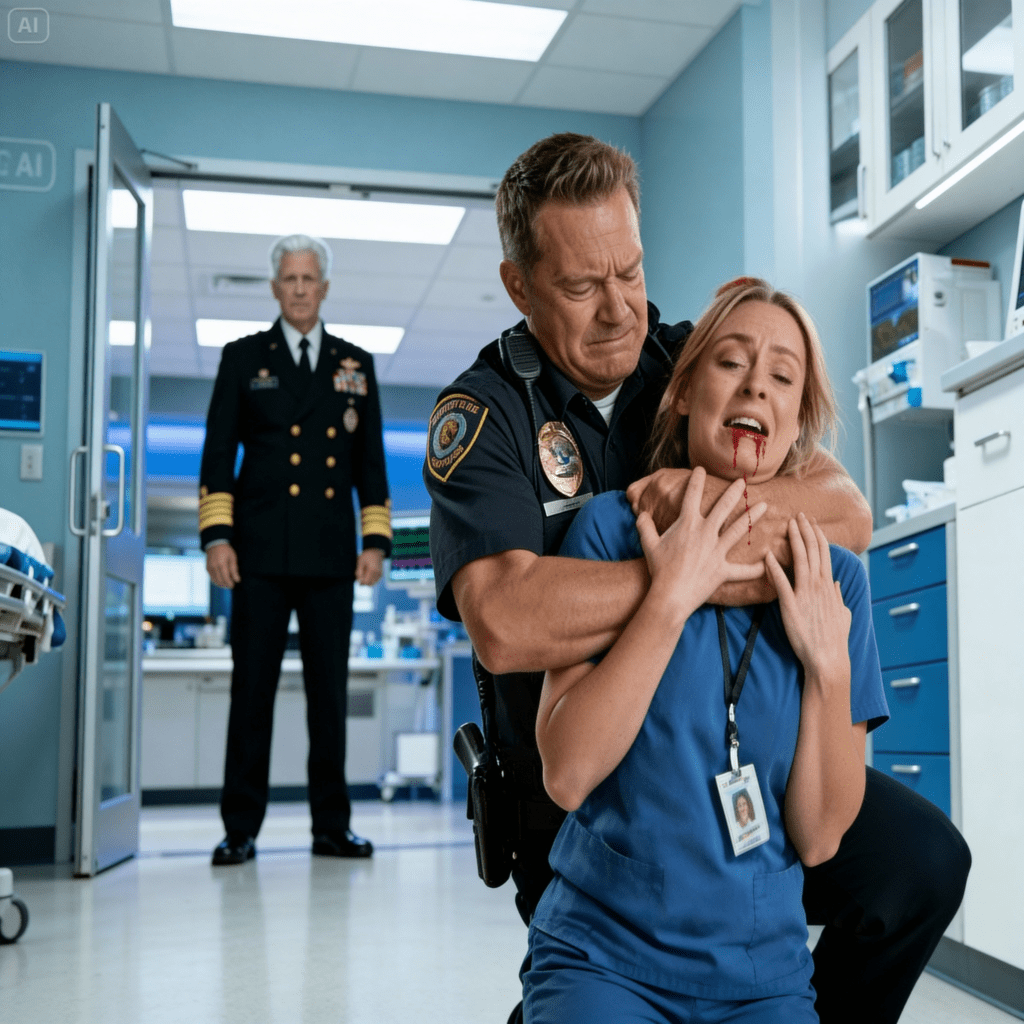
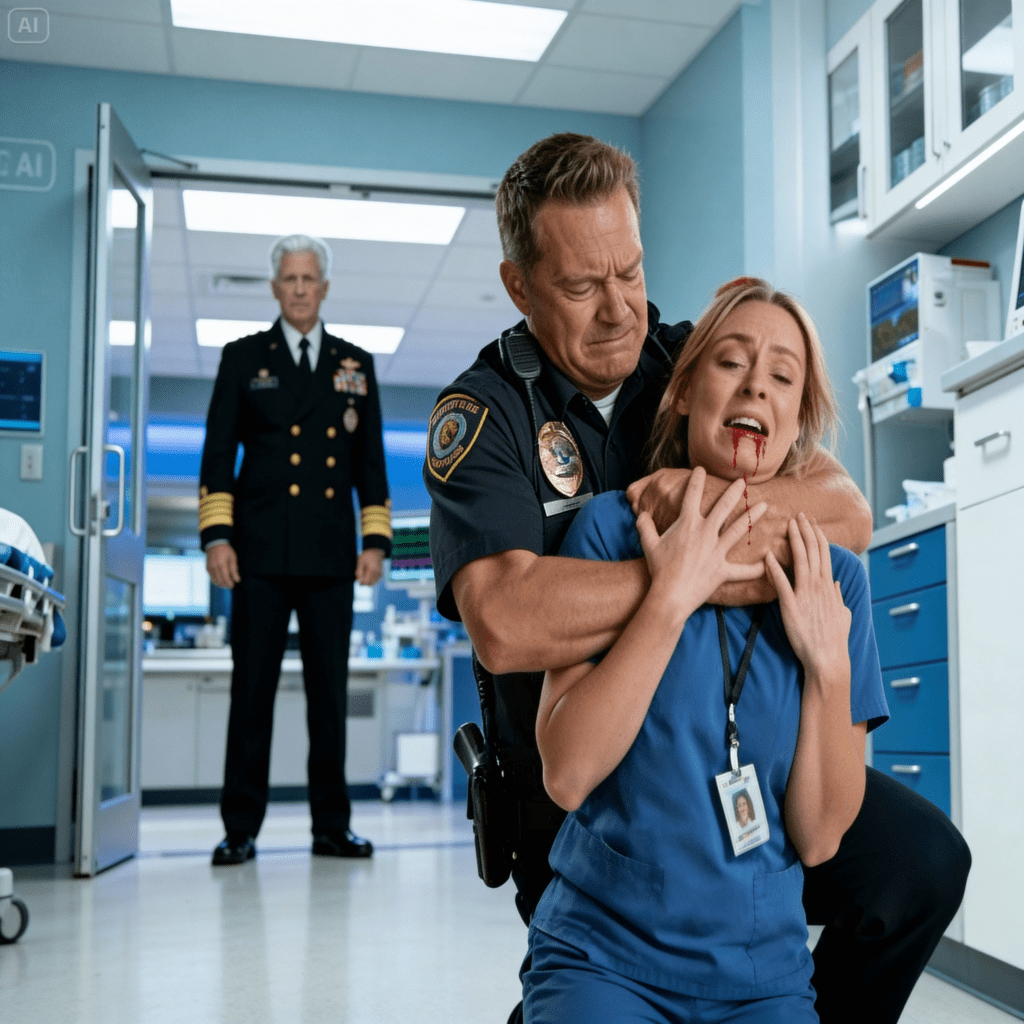
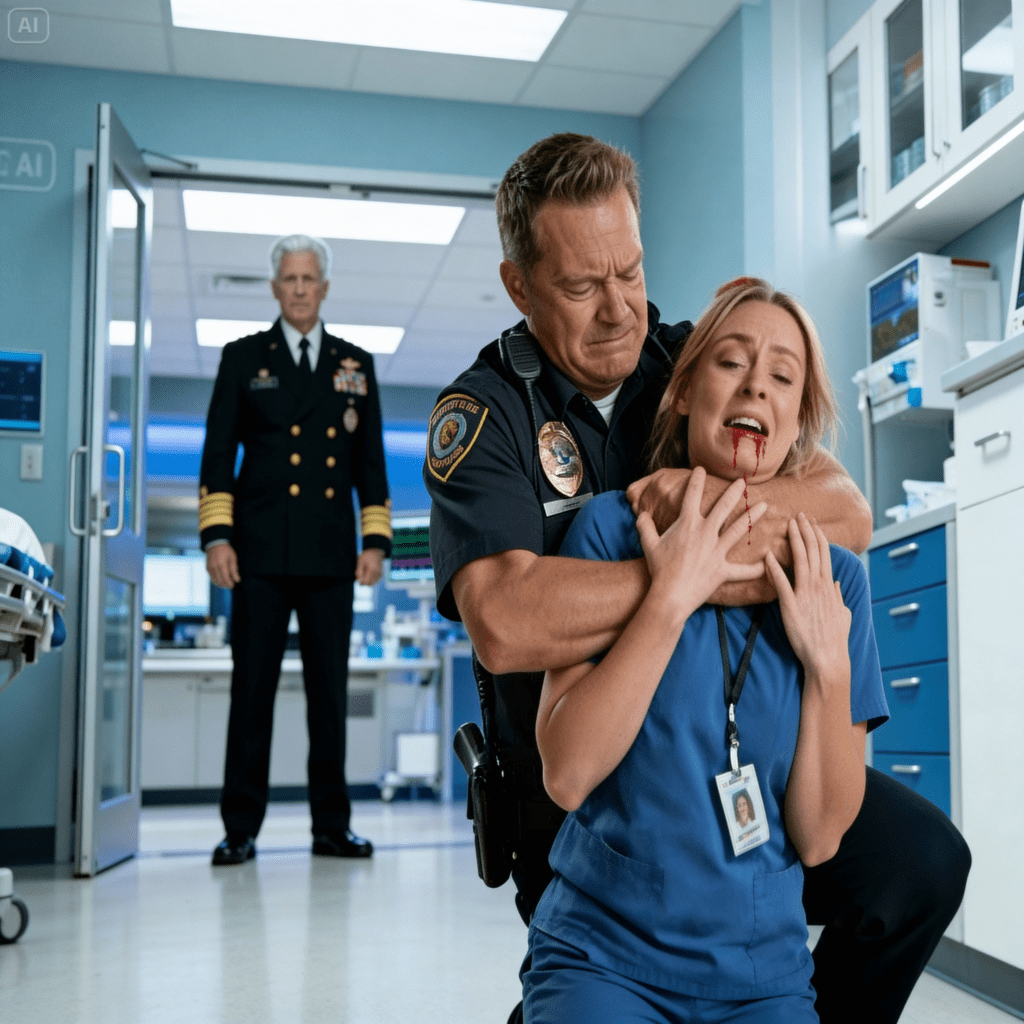
He grabbed Elena by the scrub collar first, then by the throat when she tried to step back, pinning her hard enough against the trauma cart to rattle metal trays. Gasps tore across the room. Sophie’s mother screamed. One of the younger nurses shouted for security, but nobody was close enough, and nobody expected a sworn officer to assault a nurse in front of children and patients.
Elena clawed at his wrist, not wildly, but with the disciplined reflex of someone still trying to remain functional while her airway narrowed. Boone’s face hovered inches from hers, red with rage.
“You will treat my prisoner,” he hissed, “or I will make you.”
And then, just as the room tipped from shock toward total collapse, the ambulance bay doors opened behind him.
A man in a dark overcoat stepped in, silver-haired, broad-shouldered, carrying the kind of quiet authority that makes noise rearrange itself.
He looked once at Boone’s hand around Elena’s throat.
Then he said, in a voice so calm it froze the entire ER, “Officer, remove your hand from Lieutenant Mercer. Right now.”
Nobody there knew yet why a Navy admiral was walking into a county emergency room in Ohio.
Nobody knew why he had called Elena by a rank no one at the hospital had ever heard.
And nobody, least of all Officer Travis Boone, understood that his career had just ended before he even let go.
So who exactly was Elena Mercer—and why did a Navy admiral walk into the ER at the precise second a violent cop put his hands on her?…. To be continued in c0mments

Officer Travis Boone loosened his grip only because the voice behind him carried a level of command his body obeyed before his pride could catch up.
Elena staggered backward, one hand at her throat, pulling air in sharp, painful breaths. A respiratory therapist caught her elbow. Across the room, little Sophie Hale let out a ragged wheeze that yanked the staff back toward the real emergency. Elena pointed toward the child before she could even speak.
“Airway first,” she rasped.
That was Elena Mercer in one gesture. Choked in front of the entire department, and still directing care toward the patient most likely to die.
The man in the overcoat stepped fully into the light. He was in his sixties, posture straight as steel, his expression controlled but lethal in a way only highly disciplined men ever achieve. Behind him came two uniformed aides and a hospital administrator who suddenly looked as if he regretted every career decision that led to this hallway.
Boone turned, trying to recover authority through volume. “Who the hell are you to—”
The older man cut him off without raising his voice.
“Admiral Nathan Calder, United States Navy.”
The room fell silent.
Boone blinked, once, then glanced around as if somebody might save him from the fact that he had just assaulted a nurse in front of a three-star admiral. But Admiral Calder was not there as a random witness. The way he looked at Elena made that obvious.
He knew her.
That was the second thing that began unraveling Boone’s world.
While security finally rushed in, Elena forced herself upright and moved back toward Sophie’s bay, voice raw but steady. The child’s oxygen saturation had dipped again. She directed the nebulizer dose, repositioned the mask seal, and called for the pediatric cart without wasting one more second on the officer who had just put his hands on her.
Admiral Calder watched that with a hard, unreadable face, then turned to the hospital administrator. “Get that man disarmed and outside. Now.”
Boone tried a final defense. “This nurse interfered with police custody—”
Admiral Calder stepped closer, not theatrical, just absolute. “You assaulted medical personnel during active triage and obstructed emergency care for a critical child. Every camera in this department just watched you do it.”
That was when Boone looked up and finally noticed the dome cameras above the medication station and the trauma bay entrance. His face changed.
So did the detainee’s. The handcuffed man with the thigh wound had long since stopped shouting. Even he understood the hierarchy had flipped.
Once Boone was removed from the room, the emergency department seemed to inhale again. The regular violence of medicine resumed—oxygen, suction, charting, orders, crying, cleanup. But beneath it ran a second current now: everyone wanted to know why Admiral Nathan Calder had called Elena “Lieutenant Mercer.”
Dr. Owen Pike, the attending on duty, asked first when Sophie finally stabilized enough to move upstairs.
“Elena,” he said carefully, “what did he mean?”
She stood at the sink, washing blood and glove powder from her hands. The red pressure marks on her neck were deepening. She looked tired suddenly, not physically, but in the heavier way secrets exhaust people.
“I served before nursing school,” she said.
That answer was too small for the room.
Admiral Calder gave her a long look, then answered for her.
“Lieutenant Elena Mercer was a Navy trauma officer attached to Special Warfare support operations. She earned a Silver Star in Helmand Province for holding a surgical triage station under direct fire for forty-three minutes.”
Nobody moved.
Owen Pike stared at her like he had been speaking to a stranger for two years.
Elena dried her hands slowly. “That was a long time ago.”
But it wasn’t just some old line on a résumé, and everyone understood it now. Her calm under pressure. Her refusal to be intimidated. The way she triaged like noise could never move her off principle. It hadn’t come from personality. It had been built somewhere harder.
Then Admiral Calder dropped the part that mattered most.
“I was on my way here because Lieutenant Mercer is the emergency medical proxy for my daughter and grandson. The little girl she just saved is my granddaughter.”
That landed even harder than the military record.
Officer Boone had not just assaulted a nurse. He had assaulted the woman protecting the admiral’s family while interfering with a child’s emergency treatment in full view of staff, civilians, and cameras.
By then, Ashford police command was already calling.
But the real collapse came twenty minutes later, when internal hospital security pulled the video and Elena finally spoke the sentence that made the whole case bigger than a single violent officer:
“This wasn’t about one bad temper,” she said quietly. “He knew exactly what he could get away with—because he’s done this before.”
And once that possibility entered the room, Travis Boone’s chokehold stopped looking like an isolated explosion.
It looked like the exposed edge of a much longer pattern.
The footage ended Officer Travis Boone’s version of the story before it ever began.
Three cameras captured the incident from different angles. One showed him entering the emergency room already agitated, barking over staff and pointing toward his detainee’s stretcher. Another recorded Elena clearly directing her team toward Sophie Hale, the child in respiratory distress. The third, from above the trauma cart, showed Boone grabbing her by the collar and then the throat while she was still issuing treatment orders.
No ambiguity.
No mutual confrontation.

No confusion.
Only violence.
By sunrise, Boone had been placed on administrative leave, disarmed, and served notice of an internal affairs review. But Admiral Nathan Calder did not treat it as a local personnel issue. He called in federal patient-care obstruction statutes, requested preservation of every hospital recording, and made one other demand that changed the case completely: a review of Boone’s prior contact history with medical staff in custody-related incidents.
That review found more than anyone at Hard Grove Memorial wanted to admit.
Two nurses had previously complained that Boone used physical intimidation while demanding priority treatment for detainees. One paramedic described him threatening to “shut down” an ER bay if his prisoner was not seen first. A resident physician had once written an incident note about Boone pushing past a trauma line, but it disappeared from the county system after a supervisor marked it “resolved by discussion.” No one had pressed further because nobody wanted war with the department over a single officer known for aggression.
Elena read those findings in a conference room twelve hours after being attacked.
She wasn’t surprised.
That was the bitterest part.
People asked whether she wanted to go home early, whether she needed a break, whether she should file down to partial duty. She shook her head. A child was alive because she had refused to back down. Nothing about that made her want less of the work. It only made the lines clearer.
Dr. Owen Pike came to find her near the staff lockers just before dawn. He held two coffees and looked like a man learning humility in real time.
“I was wrong about you,” he said.
Elena gave him a tired glance. “That seems to be going around.”
He almost smiled, then didn’t. “No. I mean all of it. The way I spoke to you. The way I assumed.” He handed her one cup. “You’ve been carrying more than I bothered to see.”
Elena took the coffee. “I didn’t exactly advertise.”
“That’s not an excuse for me missing it.”
It wasn’t an apology shaped for theater. That made it worth more.
The legal side moved fast after that. Boone was charged with assault, official misconduct, and interference with emergency medical operations. The county tried at first to frame the issue narrowly—one officer, one bad shift, one regrettable incident. That version died when the prior complaints surfaced and when Sophie’s mother agreed to testify that the nurse protecting her daughter was being strangled while her child struggled to breathe.
Admiral Calder never had to shout.
His presence alone turned what might have been buried into something impossible to contain. But Elena understood, better than anyone, that rank was not the true reason Boone fell. Cameras mattered. Witnesses mattered. Records mattered. Most of all, the child had lived. It is harder to erase a nurse’s credibility when the patient she prioritized is still breathing because she chose correctly.
A year later, Hard Grove Memorial looked much the same from the outside. Same tired brick façade. Same ambulance bay lights. Same stream of people arriving on the worst days of their lives. But inside, some things had changed.
Custody transport protocols were rewritten.
Medical priority authority was reinforced in policy.
Panic buttons were installed in triage.
Police access inside critical care zones became conditional and documented.
And Elena?
She stayed.
That surprised outsiders most, the people who thought dignity required dramatic departure. But Elena had never needed exit as proof of strength. She remained in the ER, still steady, still sharp, still the nurse families looked for when things stopped making sense. Dr. Owen Pike eventually offered her a formal leadership role in trauma operations. She accepted, not because titles mattered, but because the right to shape the system mattered more after seeing how close it came to failing.
On certain nights, when the waiting room was too full and the alarms blended into a single exhausted pulse, Elena would catch sight of the faint pale scar lines that had replaced the bruises on her neck. They reminded her of two things at once: what someone had tried to take, and what he had failed to break.
One spring afternoon, Admiral Calder returned with Sophie, now healthy and noisy and carrying a stuffed dolphin almost bigger than her head. The little girl ran straight into Elena’s legs and hugged her without warning.
“You fixed my breathing,” Sophie said.
Elena knelt and smiled. “You did the hard part.”
From across the room, Owen Pike watched that and shook his head once, as if still adjusting to the truth that the quiet nurse he once underestimated had always been the strongest person in the department.
Because that was the lesson the whole hospital learned too late and exactly in time:
Real courage is not loud.
It does not announce itself.
It simply holds the line when someone dangerous thinks nobody will stop them.
If this story moved you, share it, comment below, and remember: protecting the vulnerable is never insubordination.