
AT TWENTY-TWO, I SAT AT THE THANKSGIVING TABLE WHILE MY FATHER TOASTED MY “SUCCESSFUL” SIBLINGS—THEN TORE INTO ME WITH A JOKE ABOUT NOT ENDING UP SCRUBBING TOILETS, LIKE MY JOB AS A JANITOR MADE ME THE FAMILY DISAPPOINTMENT. WHAT HE DIDN’T SEE WAS EVERYTHING HAPPENING BEHIND THE SCENES—THE LATE-NIGHT CLASSES, THE MONEY I WAS STACKING, THE RUN-DOWN PROPERTIES I WAS BUYING ONE BY ONE, AND THE BUSINESS I WAS BUILDING IN SILENCE WHILE HE KEPT LAUGHING. YEARS LATER, WHEN SOMEONE TRIED TO TEAR IT ALL DOWN—BREACHING MY SYSTEMS, FAKING EMERGENCIES, AND ALMOST COSTING ME EVERYTHING—THE DIGITAL TRAIL LED STRAIGHT BACK TO MY PARENTS’ HOUSE. AND THEN, ONE COLD MORNING, THE SAME MAN WHO ONCE HUMILIATED ME SHOWED UP OUTSIDE MY OFFICE, HOLDING A FOLDER LIKE HE NEEDED SOMETHING FROM ME… BUT BEFORE I LET HIM SAY A WORD, I OPENED A FILE HE NEVER KNEW EXISTED.
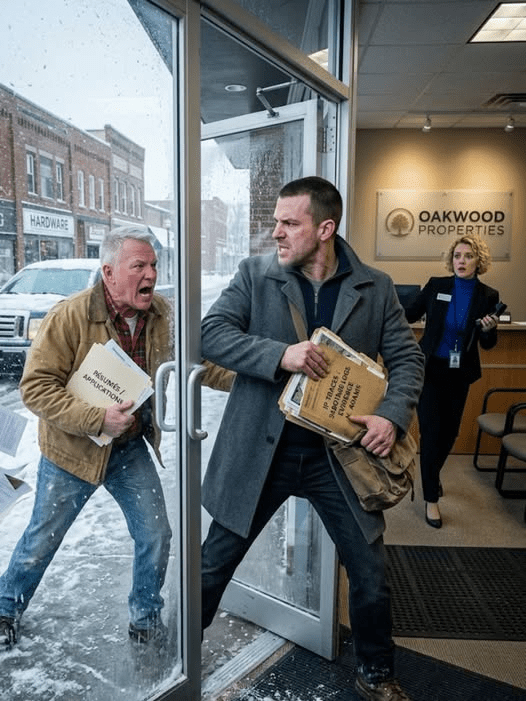
The first time I saw my father waiting for me—really waiting, not expecting—I almost didn’t recognize him.
Snow had settled across his shoulders, dampening the fabric of a coat that looked too thin for the cold. He stood just outside the glass doors of a building with my company’s name etched across the front, clutching a worn manila folder like it was the only thing keeping him steady.
For a second, I thought I had the wrong person.
My father had always been larger than rooms. He didn’t enter spaces—he claimed them. Every dinner table, every conversation, every holiday gathering somehow bent around him. He spoke like he expected agreement, joked like he expected laughter, and carried himself like belonging was never in question.
I had never seen him hesitate.
But there he was—shifting his weight, glancing at the door, looking like a man trying to calculate how much pride he’d have to swallow just to knock.
My name is Caleb.
And when I was twenty-two, my father made me the punchline of a joke in front of the entire family.
At the time, I worked as a janitor in a downtown office building.
No title. No prestige. Nothing flashy enough to impress people who measure success by suits, corner offices, or the price tag on a wristwatch.
But it was honest work.
And in ways no one in my family ever cared to understand—I didn’t hate it.
I liked the quiet hours before sunrise, when the building still felt like it belonged to no one. I liked the rhythm of it—the predictability. Trash, restrooms, offices, hallways. The way a place could go from neglected to spotless if you just paid attention long enough.
I liked learning how everything functioned behind the scenes—the heating systems, the wiring, the hidden problems people ignored until they became expensive.
Most of all… I liked that I was building something.
Just not in a way anyone could see yet.
Because the job was never the destination.
It was the starting point.
While I cleaned offices by day, I studied at night. Business courses. Real estate fundamentals. Contracts. Zoning laws. Property management. Anything I could get my hands on.
Every paycheck—I saved.
Every spare dollar—I invested.
Small, ugly buildings no one wanted. Places other people overlooked because they couldn’t see past the surface.
I wasn’t lost.
I was laying a foundation.
But none of that mattered to my family.
Because they never asked.
In my father’s version of the story, I was the failure.
My brother Mason wore tailored suits and talked about finance like he owned the concept. My sister Leah lived in curated perfection—filtered photos, polished life, everything designed to look effortless and expensive.
They fit.
I didn’t.
That Thanksgiving—the one I’ll never forget—was when it all became undeniable.
Same house I grew up in. Same staged perfection. The smell of butter and herbs filling the air. Noise from the TV in the other room. My mother moving through the house like everything had to be just right, even if nothing actually was.
I showed up with a homemade pie and a cheap six-pack.
It was what I could afford.
And maybe… a small part of me still believed that contributing meant something.
No one really noticed.
A few distracted greetings. Nothing more.
Mason was already holding court in the kitchen, talking money. My father nodded along like every word proved something. Leah was showing off photos of her latest trip—perfect lighting, perfect angles, perfect life.
My mother smiled at her.
Then asked me to move my drinks so they wouldn’t be in the way.
Dinner started the way it always did—loud, crowded, full of tradition that felt more like performance than connection.
My father sat at the head of the table like he always did.
And like always… he made a speech.
He raised his glass, smiled toward Mason and Leah, and said,
“To the kids who made something of themselves.”
Polite laughter.
Then he added, almost casually:
“And to working hard enough that you don’t end up cleaning toilets for a living.”
It wasn’t the words.
It was the silence that followed.
That brief, suffocating pause where everyone understood exactly what he meant—and chose not to interrupt it.
A fork clinked.
Someone cleared their throat.
Mason smirked.
Leah’s husband laughed under his breath.
My mother didn’t look up.
That told me everything.
I sat there, hand wrapped around my glass, feeling something familiar settle deep in my chest.
Not new pain.
Old pain.
The kind that had been building for years.
The worst part?
He didn’t even look at me.
That was his way.
Turn you into a lesson… without ever acknowledging you directly.
I didn’t argue.
Didn’t defend myself.
Didn’t finish my meal.
I stood up quietly, carried my plate to the kitchen, set the pie down without saying I made it, grabbed my coat… and walked out.
No one stopped me.
No one followed.
No one called that night.
Or the next day.
That was when it finally clicked.
In my family, silence wasn’t neutral.
It was agreement.
What they never knew—
what they never once bothered to ask—
was that the janitor job…
was never the whole story.